Tarantino promotes his upcoming film “Django Unchained” on the Howard Stern Show. Like most of Tarantino’s films, the 74-minute interview is shocking, hilarious, profane, politically incorrect, and most of all, fun. Not only is Tarantino a great guest, but Stern proves once again he’s one of the best interviewers around. As you can imagine, not safe for work or little ones.
Of all the high school movies I’ve seen (good and bad), “Dazed and Confused” is the closest approximation to what I actually experienced. No, not because of the smokin’ and tokin’ or ritualized hazing. But more because the film is arguably the least sensational film ever made about teenagers.
Think about it, half the movies about teenagers are either leaden with doom and gloom (“Rebel Without a Cause,” “Kids,” “River’s Edge”). The other half portray teen life to be a non-stop hedonistic Bacchanalia of sex, drugs, booze, etc. While the characters in “Dazed” certainly party, the party in question is just a simple beer bash with one keg where the usual things happen: some people get into fights, some people hook up, some people act like fools, though most of the partygoers don’t do any of these things. At the end of the party (when the booze runs out), most people go their separate ways and that’s that. Nothing life changing happens, no character dies to show us that “partying is bad,” nobody gets laid and becomes a different person, and interestingly, no sense that this party changed any lives, good or bad. It’s just … over … and on to the next day.
The next time you watch “Dazed,” carefully look at the way it’s edited and shot. While the film has a lot of comedic moments, there’s an odd sense of dread permeating the entire film. Canadian film critic Robin Wood was the only person to describe it as a horror film and Linklater apparently wrote him a personal “thank you” note for noticing this. The dread that I get from “Dazed” has more to do with the sense that what lies ahead may not be as cool as the characters think it will be. There’s a lot of sequences that are shot in slow motion with sound mixing that doesn’t look anything like you’d see in a comedy. In my mind, the sense that nothing ever changes and/or necessarily gets much better is horrific enough for Linklater, that showcasing a death or OD or some other traumatic event would be overkill.
The other interesting thing (and why it reminds me so much of my youth), is the distinct lack of rigid divisions between cliques. Certainly, cliques exist in both “Dazed” and the high school I went to. But most people I knew may have belonged to a certain group, but most mingled freely with others. A lot of high school films, from “Mean Girls” to “Heathers” to most of John Hughes’s oeuvre portray a caste system worse than India’s and maybe that’s true for some schools, but it wasn’t my high school experience. Maybe I’m seeing a rosier past that I actually experienced, but I remember seeing “The Breakfast Club” and “Pretty in Pink” when I was a teenager, and while I could identify with certain things, a lot of it seemed like alien territory to me.
The attached trailer gives a decent flavor for the film, but it’s regretful that it’s played up like a Cheech and Chong comedy. Granted, I wouldn’t know how to market this thing either (complex works of art usually are), but I think the advertising campaign gave a false idea of what this movie was and I think this is why it took a LOOOOONG time to find an audience. Thankfully, it did.
One of the best and creepiest films of the year is Craig Zobel’s indie drama “Compliance.” Based on a stranger-than-fiction true story, the film is about a manager at a fast food restaurant who receives a call from someone who says they’re a police officer. The caller says that one of the employees has stolen from a restaurant patron and that the manger needs to detain the employee until the police arrive. Through verbal manipulation, the caller has the manager (and others) perform an increasingly bizarre, disturbing, and illegal series of activities on the employee.
“Compliance” has garnered a lot of praise … and a lot of walkouts. Many people can’t believe that others would be so stupid, that they would commit heinous acts because someone who sounds like they’re an authority figure told them to. But they do. And it happens more frequently than you would think. “Compliance” is based on a real case that happened in 2004 in Kentucky, and what happened is actually not an isolated occurrence. It’s called the “strip search prank call scam,” and there’s loads more details at this Wikipedia article:
As for the film, Zobel has done a solid job showing how this sordid series of events went down. Actress Ann Dowd, who plays the manager, has already won Best Supporting Actress from the National Board of Review for her performance. This was also one of director John Waters Ten Best Films of 2012.
One of my favorite December rituals is looking to see what films irreverent, but legendary filmmaker John Waters has selected for his 10-best films of the year in Artforum magazine. Below is the list, but his commentary at the Artforum website (located at the link) above is a must-read.
The Deep Blue Sea – Terence Davies
Paradise: Faith – Ulrich Seidl
Paradise: Love – Ulrich Seidl
Amour – Michael Haneke
Killer Joe – William Friedkin
Beasts of the Southern Wild – Benh Zeitlin
Compliance – Craig Zobel
Marina Abramović: The Artist Is Present – Matthew Akers
A great interview with legendary screenwriter Joe Eszterhas by Howard Stern from June 2012, focusing on Eszterhas’s disastrous collaboration with Mel Gibson. Pretty funny in a lot of spots, but also a fairly disturbing look at Gibson. If you’re interest is piqued, you seriously need to read the Amazon Kindle single “Heaven and Mel”which goes into much more detail. It’s the length of a 150 page book, but it’s only $2.99. One of the most harrowing and hair-raising True Hollywood Stories you’ll ever read. To be fair, aside from Mel’s minor rebuttals, we haven’t heard Mel’s complete side of the story. However, Eszterhas does make a good case and rightly or wrongly, as Mike Ovitz learned, “Don’t f–k with Eszterhas!”
Lots of bad language and adult subject matter so not safe for work or little ones.
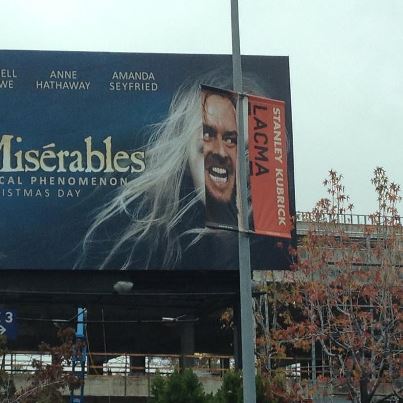
This Christmas, Jack Nicholson IS Cosette in the long-awaited adaptation of the musical “Les Miserables” … featuring Jack’s heartbreaking rendition of “I Dreamed a Goddamned Dream”
I realize I’m going to lose a lot of credibility points on this one, but f–k it! Yes, this is hopelessly contrived. Yes, it inspired a horrendously insipid genre of all-star casts falling in love around the holidays. But this is one of my all-time favorite films and one that always brings a smile to my face. This is probably my biggest guilty pleasure, but I don’t feel that guilty about it. There’s terrific acting (especially by Alan Rickman, Emma Thompson, Bill Nighy, and Laura Linney), a smart script, and is one of those movies that genuinely tries to make you feel good … and succeeds. Next to “A Christmas Story” and “Bad Santa,” this is my all-time favorite Christmas film.
For penance, I tried finding a link to the parody that “30 Rock” did for their own version of “Love Actually”: “Martin Luther King Day” … but alas, this no longer available in good quality on the net.
One of the most moving portrayals of a marriage ever put on film was in Disney/Pixar’s 2009 Oscar-winning animated film “Up.” The attached montage has no spoken words, and is a combination of two pivotal scenes from the film: one towards the beginning … the other towards the end. However, both scenes bookend each other nicely and I’m glad someone put these two scenes together. One of the most remarkable things I’ve ever seen on film. Warning: you will not have a dry eye watching this.
Nowadays, Bob Fosse has sadly become a pop culture joke. Anytime one wants to make fun of musical theater, they throw up jazz hands and say “FOSSE!” dramatically. However, the man was a true pioneer of modern musical theater and also made some amazing films. His filmography is short, but not many can boast as much popular and critical acclaim as Fosse achieved. Three of the five films he directed (“Cabaret,” “Lenny,” and “All That Jazz”) were nominated for Oscars for Best Picture and Best Director (he won for “Cabaret’) and were box-office hits.
However, Fosse’s best and strangely, most critically and commercially reviled film was 1983’s “Star 80.” “Star 80” is the sad, oftentimes unbearably intense and depressing biography of 1980 Playboy Playmate of the Year Dorothy Stratten, who was brutally murdered by her estranged husband and former manager, suitcase pimp Paul Snider. Critics complained that Fosse focused too much on Snider and not enough on Stratten. While this is not necessarily unwarranted criticism, Fosse’s exploration of Snider is one of the most complex and empathetic portrayals of a human monster ever committed to celluloid. Richard Gere was originally attached to play Snider, and while he would have been good, Eric Roberts was by far, the better choice to play Snider and his portrayal of Snider is one of the most ferocious performances I’ve ever seen on film. Between 1978’s criminally underrated “King of the Gypsies” and “Star 80,” Roberts really should have become a powerhouse star/actor on par with Robert DeNiro and Sean Penn.
From Martin Gottfried’s brilliant biography of Fosse “All His Jazz: The Life and Death of Bob Fosse”, Gottfried relayed a chilling tale of how Roberts finally understood how to play Snider. Roberts had a lot of difficulty with the role, breaking down and telling Fosse “S–t! I don’t know what the f–k I’m doing.” Fosse chillingly grabbed Roberts, stared into his eyes and said “Look at me! If I weren’t successful … if I weren’t successful … look at me … that’s Paul Snider. That’s what your playing. Now show me ME!” The attached clip, from the beginning of “Star 80” with Roberts, tells you all you need to know about Snider. However, the clip does contain nudity and bad language, so not safe for work or little ones.
You may or may not know who Polly Platt is / was, but Platt was a dynamic creative force in Hollywood from the late 1960s through the 1990s. She was married to (and then famously divorced from) acclaimed director Peter Bogdanovich and was production designer (and, as many people believe, contributed significantly more creatively) on all of his early 1970s masterpieces/hits (“Targets,” “The Last Picture Show,” “What’s Up Doc?,” “Paper Moon”). She wrote the screenplay for Louis Malle’s controversial English language debut film “Pretty Baby.” She was the art director on “Terms of Endearment” and co-produced many of James L. Brooks’s films, including “Broadcast News” and “War of the Roses.” She was the producer of Cameron Crowe’s classic “Say Anything.” And, she was responsible for plucking Wes Anderson and Owen Wilson out of nowhere, producing their stunningly hilarious debut “Bottle Rocket” in 1996.
Her marriage to and divorce from Bogdanovich was fictionalized in the conventional, but clever Hollywood satire from 1984 “Irreconcilable Differences” (with Shelley Long playing the Platt character and Drew Barrymore playing her daughter).
Platt sadly died in July 2011, but her contribution to American film over the last 50 years can not be underestimated. For more on the Platt story, please read Peter Biskind’s classic book on 1970s Hollywood “Easy Riders, Raging Bulls” and more significantly, Rachel Abramowitz’s exhaustive look at women in Hollywood from the 1960s through the new millenium, “Is That a Gun In Your Pocket?”
Below are trailers for her greatest films:
The Last Picture Show (1971)