In honor of this year’s Cannes Film Festival (taking place as we speak), here’s one of the best-known and most beloved of all the Palme D’Or winners, 1994’s “Pulp Fiction.” There’s not much more I can say about the “Star Wars” of the 1990s that hasn’t already been said. I had seen Quentin Tarantino’s first film “Reservoir Dogs” on its opening weekend at an upscale Arlington, VA art theater in the fall of 1992, after reading about it nearly a year before in the magazine “Film Threat.” After seeing “Dogs,” I obnoxiously demanded that everyone I knew at the time see this film, carrying a VHS copy of the film to practically every gathering I went to for the next year and a half. A year later, I saw the Tarantino-scripted “True Romance” twice on its opening weekend in 1993 and became an even more annoying (and mouth-breathing) Tarantino disciple. Needless to say, by the fall of 1994, especially after it won the Palme D’Or at Cannes and had so many major critics vehemently raving about it (or condemning it), I could barely contain my excitement when “Pulp Fiction” finally made its US debut. This time, I saw it at a Tuscaloosa, AL mall multiplex, which was a real sign that the underground planets had aligned and Tarantino’s blend of violence and comedy had become VERY chic by this point.
Mark Seal recently composed a very lengthy, but immensely entertaining article about the making of “Pulp Fiction” for Vanity Fair’s March 2013 Hollywood issue, which you can read at the link below:
Many people would argue that Samuel L. Jackson’s turn in Quentin Tarantino’s “Pulp Fiction” was his breakout role. I would argue it came 3 years earlier in Spike Lee’s “Jungle Fever” playing Wesley Snipe’s crackhead brother Gator. Jackson’s performance was BEYOND f–king intense and earned an unprecedented Best Supporting Actor nod at the 1991 Cannes Film Festival. “Jungle Fever” is flawed (Spike Lee’s subsequent films “Malcolm X, “Get on the Bus,” “Summer of Sam,” “Bamboozled,” and “The 25th Hour” are arguably much better), but it has a lot of terrific virtues. This scene never fails to put a chill up my spine.
At some point, I’m going to write an essay on Robert Altman’s classic 1970 film “M*A*S*H” and how much this movie has meant to me over the years. It’s a film that seems even more shocking and subversive these days than it did when it first came out over 40 years ago. But the story behind the theme song “Suicide is Painless” is so damn interesting, it demands its own essay. Most people know the melody, as it played over the opening and closing credits of the TV show. But for those people who don’t know that the movie exists are usually genuinely shocked to hear that the theme actually has lyrics. Marilyn Manson once said that this is the most depressing song ever written. The lyrics are pretty despairing … but director Robert Altman would’ve probably said “Are you f–king kidding me?!?” to such sentiments.
The following story below is a summary of several anecdotes related in the positively amazing oral history / biography of director Robert Altman “Robert Altman: The Oral Biography” by Mitchell Zuckoff. (What?!? You don’t have a copy of this amazing book ?!?)
The impetus for writing the song came from a scene in the middle of the film where a dentist character, a legendary cocksman of the medical unit, finds himself impotent when he hooks up with a woman and concludes that he’s gay. As a result, he wants to commit suicide. His friends think this is utterly ridiculous and treat the dentist’s desire to kill himself with absurd humor. They hold a “last supper” that’s framed in the same way as Leonardo Da Vinci’s famous painting. Altman thought there was too much “dead air” in the scene and that it needed a song. Per Altman, “It’s got to be the stupidest song ever written.” The composer, Johnny Mandel, said “Well, we can do stupid.” Altman said “There’s too much stuff in this 45-year old brain of mine. I can’t get anything nearly as stupid as I need. But all is not lost. I have this kid who is a total idiot. He’ll run through this thing like a dose of salts.” Altman’s son Michael (who was reportedly 14 years old at the time) was asked by his father to write the lyrics and he wrote the lyrics in approximately 10 minutes. Altman’s son wrote some chords … Mandel added some others … and the song was a done deal.
For Michael’s trouble, he was paid $500 and 50% of the song. A few years after the movie came out, the TV series “M*A*S*H” came out and he got a check for $26. Then he received a second check for $130. And then the show went into syndication and Michael received a check for $26,000. And after all was said and done, Michael earned $2 million over the years for writing an allegedly really stupid song in just 10 minutes. To put this into perspective, his father Robert only received $75,000 for directing the movie … with no royalties or profits. Keep in mind that the movie “M*A*S*H” is considered one of the greatest film comedies ever made, was ranked #54 in the American Film Institute’s poll of the greatest American films ever made, was deemed “culturally significant” by the Library of Congress and was selected for preservation in the United States National Film Registry,won the Palme D’Or at that year’s Cannes Film Festival, was nominated for Best Picture and Best Director Oscars, and grossed the equivalent of $475 million in 2013 dollars.
Michael admitted that he squandered most of the money, failed to pay taxes because he was young and not money savvy, and then got into a lot of trouble with the IRS. Eventually, Michael had to declare bankruptcy and his father Robert bought the song for $30,000. So his father (and his estate) wound up with future royalties after the fact.
After several years, Michael admitted that he blames himself entirely for what happened and while that he’s written other songs, no others have been recorded or released. He advised by his standards, he never liked the song or was that impressed with it.
I heard this amazing insight writer/director/producer Judd Apatow had about his own neuroses on Marc Maron’s extraordinary WTF podcast from 2011. Maron asked him why they don’t feel any sense of joy and Apatow’s answer made perfect sense to me. What’s missing from the transcript below is hearing Apatow and Maron both laughing their asses off as Apatow is explaining this. And damn if I wasn’t laughing as well… for reasons that are obvious if you know me…
Marc Maron: Why are we so afraid of joy?
Judd Apatow: That’s the question, and I’ve thought about it a lot. And I think it’s because we think that right behind joy is a knife that will cut our throat. And if we feel it, it’s almost like a laugh, and you’re chin goes up, and you’re throat is exposed. And if I laugh too loud, someone will slit my throat. And so, that’s the terror of joy. If I enjoy this as completely as I want to, it’s gonna hurt when it goes wrong. And the mistake is, it hurts already. Keeping shut down is what really hurts. And so it doesn’t actually make sense, and if you have to think about it all the time to know that’s what’s happening. Like I’m not actually enjoying this. And then you’re not present because you’re waiting for a punch. That’s how I feel like. I feel like I have my dukes up all day long, looking for someone who’s going to punch me, and here’s the thing: no one ever punches me.”
P.S. You’re not allowed to say “That’s OK Dave, I’ll punch you” in response … Not because it’s not funny, but because I’ve already thought of it.
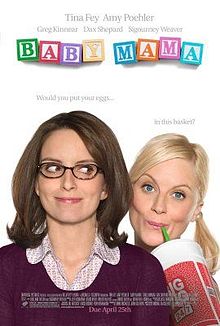
First off, some major disclaimers. I normally don’t talk about things I dislike on this blog. And to be fair, the 2008 film “Baby Mama” is far from being the worst film I’ve ever seen. It seriously doesn’t warrant the words I’m about to say about it. But “Baba Mama” represents everything I hate about many movies, let alone TV. And, more significantly, it also represents why I decided to do what I do with my blog.
“Baby Mama” is not a significant film. It was not intended to win Oscars or blow minds. I could be wrong, but I seriously doubt it was even conceived with the notion that it would make a dent … at all … in the psyches of the general public. At best, it was designed to be a lightly funny diversion for people on a Friday night after a hard work week, with the mere intention to amuse. If it amused any of you, that’s cool with me. My last goal is to piss on any text that brought genuine joy to someone in any capacity.
But this film offended me … enraged me, even. And not because it was a terrible movie. But because “Baby Mama” was so painfully mediocre. The film would have actually been better had it been terrible. Because at least I would have found something interesting about it. Aside from one funny joke about whether a brown stain on a finger was poop or chocolate, absolutely NOTHING about this film made me laugh, let alone smile. For me, it was the equivalent of watching the TV shows “Two and a Half Men” or “Wings.” Or the movie equivalent of eating a Burger King breakfast sandwich. It wasn’t good. It wasn’t terrible. The experience of watching “Baby Mama” meant absolutely … f–king … nothing. It was a void.
Where does one place the blame for a film like this? Is it the cast? I don’t know. I can say with all honesty that I genuinely like all of the major actors in this film (Tina Fey, Amy Poehler, Greg Kinnear, Dax Shepard, Sigourney Weaver, Steve Martin). I’m sure none of these talented people chose to do this because the script they read completely sucked. I realize creative people do some things for the money. But all of these people could have found a job doing something else if they didn’t find the project genuinely interesting.
The next suspect: the writer / director Michael McCullers. This was (and as far as I know) the only film McCullers has directed, after writing credits on three “Austin Powers” films. I’m sure he wasn’t expecting his first film to be “Citizen Kane,” but I think he probably thought this wouldn’t be a bad film to make his directorial debut on, considering that Lorne Michaels was a producer. And you know what? The film was competently made. I didn’t see any glaring Ed Wood-style screw-ups. Was it the script? The “Austin Powers” films he helped write were huge hits and … to varying degrees … pretty funny. Talented people can strike out creatively, but the fact that all of these talented people lined up behind it makes me think that maybe the original script had more going on with it than what resulted in the final product. Especially when you consider that most major studio comedies go through a hellish “rewriting” process where as many as 20 anonymous writers may be hired to “punch up” the script to make it “funnier,” though in most cases, whatever original spark the script had has been beaten to death or taken out entirely.
So who’s to blame for how lame the final product is? I don’t know. And I’m not the one to point fingers. Based on what I know about how movies are really made, the creation of “Baby Mama” was likely a classic example of a film run through the “machine” of a major corporate studio thinking more about “demographics” and “ancillary markets” than producing something of quality. But then again, who knows? All I know is that I didn’t have high expectations when I checked this DVD out of the library, other than to find something kind of funny and not too deep to watch for the end of a work week. And what I saw was absolutely lacking of my, admittedly, minimal expectations.
Which leads me back to why I do this blog. I’m not a film critic or movie reviewer, but I think I can say what I dislike about a film (or other text) in an intelligent manner. However, auteur theory be damned, most movies are not the result of one creative power. There are many people responsible for the creation of a film and to pinpoint what makes a particular film bad is typically based on which person behind the scenes can provide the most persuasive argument. I’m not in the industry, let alone an insider who can intelligently say what made a major film get greenlit or why it went artistically astray. All I know is what makes me laugh … turns me on … blows my mind … or make me question my existence. And because I’m in my 40s and don’t know whether I have 2/3, 1/2, 1/3, or (yikes!) even less of my life left to live, I’d rather talk about those things I like in detail, than analyze things I dislike.
I’ve been doing this blogging thing for roughly a year now. Dave’s Strange World has only been active approximately 9 months, but that’s only because my original blog (Dave’s Waste of Time) got unceremoniously yanked after 3 months to same vague violation of the “Terms of Agreement” … or something of that nature. My blog may be a lot of “happy happy” talk about “great” or “awesome” or “terrific” things (I probably need a better thesaurus), but again, I’d rather talk about things that move me, than things that make me go “eh.”
Please note that anyone who has put their heart and soul into putting together something creatively, no matter how disagreeable I may find the final product, is far ballsier than I could ever imagine to be. So even if I don’t like your creative endeavor, you get a pass from me for putting yourself on the line for doing far more than I’ve ever done. And if you’re making people happy, then screw all of those people, including myself, who try to ruin your parade.
One of the most pleasant acting surprises of the last several years was Sir Ben Kingsley’s turn as psychotic gangster Don Logan in Jonathan Glazer’s brilliant British gangster film “Sexy Beast.” Who would have thought that Kingsley, the master of playing sedate, thoughtful, mature characters would let his freak flag fly so blatantly … and excessively? Seriously, in a battle between Kingsley’s “Don Logan” and Jo Pesci’s “Tommy” in “Goodfellas,” I might give the edge to Kingsley. Maybe the bald pate makes him look more intense, but Kingsley looks like a rabid f–king dog in “Sexy Beast.” As much as I love Jim Broadbent, Kingsley DESERVED that freakin’ Oscar in 2001 for “Sexy Beast.” Or at the very least, Broadbent should have offered it to him. Because the f–king insane rage Kingsley brought to that part comes from somewhere. And I wouldn’t want to cross him in a dark alley.
This is one of the many moving scenes from P.T. Anderson’s magnificent 1999 film “Magnolia.” This is the first date between John C. Reilly’s decent police officer character Jim and Melora Walters’ troubled Claudia character. This event occurs about 2/3 of the way into the film. Jim is a very good, compassionate man who feels tremendous guilt over losing his gun on the job. Claudia is a promiscuous drug addict trying to blot out an abusive childhood. On the grand scale of things, Jim’s troubles are far less severe than Claudia’s … but somehow, they seem to be meeting at the right time in the right place in their lives. Nobody in their right mind would EVER have a first date like this … but as we all know … if we’re lucky … we know that life is strange. And sometimes fate compels you to act in ways that you otherwise wouldn’t … because you have a strange hunch that the person you happened to just meet and sitting across from could potentially change your life for the better. Granted, a lot of people choose this path and wind up with someone who is a complete disaster. But sometimes it goes the other way, too.
This scene always brings a lump to my throat and is one of the best scenes in a film that I consider one of the best of the 1990s.
Michael Cimino is one of the greatest crash-and-burn tales in Hollywood history. Cimino was someone who had bounced around Hollywood for years until he wrote and directed a Clint Eastwood hit (“Thunderbolt and Lightfoot”) in 1974. Based off that, he got the opportunity to make a more personal project … in this case, “The Deer Hunter.”
“The Deer Hunter” was based on a script that originally had nothing to do with the Vietnam War called “The Man Who Came to Play” (written by Louis Garfinkle and Quinn K. Redeker) which was about Vegas and Russian Roulette. Cimino had the script rewritten and placed the setting in Vietnam (the final screenplay was credited to Deric Washburn).
While “The Deer Hunter” went overschedule and overbudget, it still beat Francis Ford Coppola’s troubled and long-gestating Vietnam epic “Apocalypse Now” to the screen by approximately 9 months. So “The Deer Hunter,” by default, became THE first major studio film about the Vietnam War, post-Vietnam War. As a result, everyone expected (and treated) this film as a definitive statement on the Vietnam War, if only because there were no other films out there at the time about the subject.
If you see “The Deer Hunter” as a statement about the Vietnam War, the film will sadly come up short. I don’t see “The Deer Hunter” making ANY statement about the Vietnam War … at all. Now that there have been several films about the Vietnam War that have since been released, I think “The Deer Hunter” can be seen more objectively as a film about three friends who suffer a collective traumatic event and come back changed in irreparable ways.
There may be nothing to document that the infamous Russian Roulette scenes that took place in the film actually happend. But I don’t think the inclusion of these scenes says anything about the Vietnamese people or the Vietnam war. War in general is a messy, messy thing. Atrocities are committed on all sides in a war and not everyone plays fair or according to the rules of the Geneva Convention, Were all Vietcong soldiers sadistic, evil bastards who committed atrocities on American soldiers? No. Were all American soldiers sadistic, evil bastards who committed atrocities on the Vietnamese? No. Were there bad elements on both sides that committed atrocities who saw the war as an excuse to express their darkest sides? Absolutely.
Which is why, in retrospect, I can view “The Deer Hunter” less a statement about Vietnam, than what happens to three friends who suffer through a horrible tragedy and how it affects them. In my mind, the film could have removed the Vietnam element entirely and focused on another traumatic event (i.e. the one in “Deliverance”) and still have packed the same emotional and visceral punch. The use of Vietnam may have (arguably) been a cynical use of a real event for dramatic purposes. But to criticize Cimino for using Vietnam in his story is like criticizing Shakespeare for exploiting real events in several of his plays (“Julius Ceasar,” “Henry IV”). Not that I’m comparing Cimino to Shakespeare …
“The Deer Hunter” is, admittedly, a difficult film. It’s very long, has several disturbing and upsetting scenes, and is not what we conventionally see as a coherent text. But even 35 years later, it’s still an amazingly powerful film that is gut-wrenching to watch. The performances by Robert DeNiro, Christopher Walken, John Savage, Meryl Streep, and John Cazale are amazing. The cinematography by Vilmos Zsigmond is stunning. It’s still incredible that a film like this would have won a Best Picture Oscar, but it is truly deserving.
This film might still be celebrated today … if not for the fact that Cimino’s next film, “Heaven’s Gate,” was such a colossal critical and commercial flop. While many cineastes (including myself) can argue the virtues of “Heaven’s Gate,” it’s failure tainted the success of “The Deer Hunter” … to the point where several critics reversed their own opinions on “The Deer Hunter” to say that the emperor wore no clothes (Vincent Canby of the New York Times being the most notorious example). Which asks the question: “Did the critics really even love ‘The Deer Hunter’ or did they just jump on the bandwagon of praise? And by the same token, did they jump off when people turned against Cimino?”
To figure out this quandary is a useless party trick, in my opinion. While there are many parts of “Heaven’s Gate” that I admire, I still find the film severely flawed. Having said that, this doesn’t negate my appreciation of “The Deer Hunter” at all. It’s a film that never ceases to shock, amaze, and move me and is one of the best films I’ve ever seen.
I remember seeing this film for the first time on an independent over-the-air TV station uncut around 1982 or so. The film was sold to the CBS network for $5 million. But allegedly, when they discovered that they couldn’t edit this film in an adequate way, they gave up on trying to show it. The studio (Universal Pictures in the U.S.) sold the film to independent stations who showed the film uncut in two parts. All of the language, nudity, and violence was on full-display. And to best of my knowledge, there were no FCC complaints. Compare that to the ABC network’s decision to show Steven Spielberg’s “Saving Private Ryan” uncut in the early 2000s and not only did complaints flood into the FCC, but ABC was fined hundreds of thousands of dollars for showing it this way. I like “Saving Private Ryan” a lot, but even though it’s more graphically violent than “The Deer Hunter,” it’s arguably much less controversial. The times have indeed changed.
I have mixed feelings about how much of our media is being digitized these days. While I love my Amazon Kindle, love Netflix and Hulu Plus, love my Amazon Cloud Player, etc., there is a danger in trusting that elusive “cloud” to hold everything the way you like it. First of all, a “cloud” is always owned by someone else. And once you give up control to another outside force, you are totally at their mercy … despite their reassurances about how they’ll never go out of business, never be obsolete …
The conversion from film to digital (with no options) is sadly, the wave of the future. However, this story about how one year’s work on “Toy Story 2” was almost gone in less than a minute should give pause to anyone who totally embraces a digital future. Just because digital is not a physical medium doesn’t mean that it’s not fragile. This is the future, folks.
Holy mackeral! This song damn near defined my 9th grade year in junior high. To my immature ears, this was the angriest, coolest, and funniest song I’d ever heard. Though, crazily enough, I actually first heard this song in the cheesy 1983 horror film “Nightmares.” In that film, Emilio Estevez played a video game addict who played this song constantly in his headphones. In retrospect, that was the ONLY thing I remembered about that otherwise s–tty movie.
When a friend of mine played it for me a year later on a punk compilation he had copied, I freaked out like that blind guy in the 1931 Fritz Lang film “M” when he heard the serial killer humming “In The Hall of the Mountain King.” I later learned the band who did this was Fear. … who I later saw in several infamous and legendary clips on the punk TV show “New Wave Theater” … and whose lead singer Lee Ving had pivotal acting roles in several mid-1980s films (“Flashdance,” “Streets of Fire,” “The Wild Life,” “Clue”) … and who I later learned was one of John Belushi’s favorite bands before he died (Fear plays a VERY pivotal role in the final third of the infamous Bob Woodward biography of Belushi “Wired”).
Guns n’ Roses later covered this on their 1993 album “The Spaghetti Incident”.
A totally rude and nasty classic!!! From Fear’s 1982 album “The Record.” Due to multiple f-bombs, not safe for work.

 Dave's Strange World