“I’m One” – The Who from “Quadrophenia” as seen in “Freaks and Geeks”

Ever since I introduced the late 1990s TV show “Freaks & Geeks” to my son a few weeks ago, he has binge-watched the entire one-season show (18 hours) at least 5-6 times on Netflix.  It’s been nice reconnecting with the best show ever to be broadcast on TV about teenagers, if not one of the best series in TV history.

This particular scene is one of my favorites.  It’s one where the geekiest of the geeks, latchkey child Bill Haverchuck, comes home after school to watch TV by himself.  He catches an early TV appearance by comedian Garry Shandling and experiences a moment of unbridled joy laughing at Shandling and just hanging by himself.  I know that many people paint the life of a latchkey kid as unbearably tragic.  But speaking as a latchkey kid myself, sorry Dr. Laura, I had a f–king blast! And no, it’s not because I used the alone time to drink alcohol, do drugs, use my bedroom as a f–kpad, or look at porn.  I realize this is anathema to common ideas of parenting these days, but sometimes kids just need one-two hours a day to do absolutely nothing but veg.  Yes, socializing, exercising, doing school activities, etc. are important, but vegging is seriously underrated and kids these days don’t do enough of it. 

Anyway, I love the way that The Who’s “I’m One” … one of the best, but least-heralded tracks from their great album “Quadrophenia” is used in this scene.  One of the best uses of popular music for dramatic purposes ever.

“Come Sail Away” – Styx from “Freaks and Geeks” (1999)

First of all, you need to understand how much I loathe “Come Sail Away” by Styx.  If it were a federal hate crime to discriminate against a song, I’d be doing hard time in federal prison for committing crimes against this one.

But … this song works soooooo damn well in this wonderful scene from the first episode of “Freaks and Geeks,” the greatest show in television history about teenagers … and if truth be told … kicks the a– of any of the “best” feature films ever made about teenagers.

This is a scene from the Homecoming dance, where freshman Sam Weir shows up at the dance because his crush, cheerleader Cindy Sanders, promised him a dance.  She fulfills her promise and the dance between these two always lifts my mood.  Some moments are so incredibly sweet that if you dislike them, there is something seriously wrong with you.   As awkward as Sam is here, he has bigger balls than I did at the age of 14.

Andy Kaufman v Jerry Lawler

Video

A compilation of various clips and footage detailing comedian Andy Kaufman’s feud with championship wrestler Jerry Lawler from the early 1980s. If you’re a fan of the Andy Kaufman wrestling documentary “I’m From Hollywood,” this is like seeing the box set of this documentary with the complete clips present. This is not a documentary, but if you enjoy Andy Kaufman and/or professional wrestling, this is a lot of fun.

Friar’s Club Roast of Chevy Chase (2002)

http://www.dailymotion.com/video/x5px6yu

Ahhh … the infamous Friar’s Club roast of Chevy Chase from 2002. Why infamous? Many people are of the opinion that this was the meanest roast of all-time. Marc Maron, one of the roasters, said it was one of the most depressing nights of his entire life. My opinion? I’m not sure why people think THIS is the meanest roast. The Comedy Central roasts of Flavor Flav and Larry the Cable Guy were 50x meaner in my mind. The difference may be that Chevy looks like he wanted to be anywhere else but attending that roast and Flav and Larry were eating it up.

To be fair, Comedy Central tried editing this into a “fun” 1 hour special. You can tell because they seem to use the same clip of Chevy smiling multiple times … albeit through gritted teeth. Chevy allegedly said “That hurt” before stalking off the stage, but that’s not on the special that aired. From what I understand, it wasn’t the jokes that upset Chevy so much but the fact that most of the people on the dais were people he never worked with or even knew him. For more context on the roast from Chevy’s perspective, you’re encouraged to read the 2004 article from “Entertainment Weekly” at the link below.

http://insidetv.ew.com/2012/04/03/chevy-chase-archive/

My opinion? I thought it was pretty funny. But then again, he’s Chevy Chase and I’m not.

A word of warning: even though the worst words are bleeped out, this is a roast, so not safe for work or delicate sensibilities.

The “fat girl” speech from “Louie”

Video

I don’t have much to add to all the praise and hubbub that this episode is generating out there. But it’s a prime illustration of why “Louie” is one of the coolest, ballsiest TV shows of all time. “Louie” has continually been one of those shows that’s hysterically … oftentimes profanely … funny, but isn’t afraid to get serious if that’s what the moment calls for. And when I mean serious, it’s not in “a very special episode” kind of way. The common denominator on “Louie” is exposing what’s real. It treads the line between funny and serious better than almost anything I’ve ever seen.

A friend of mine once told me he had difficulty seeing what all the fuss was about re: “Louie.” I advised to not think of it like a sitcom, but to watch it the same way you would watch a Spike Lee film. Lee’s films are oftentimes really funny and serious as s–t … sometimes going back in forth several times between both poles in scenes lasting no more than 5 minutes.

Interview with Bob Zmuda by Marc Maron

Video

This is a lengthy, riveting, and extremely funny interview with Bob Zmuda, late comedian Andy Kaufman’s partner-in-crime that Marc Maron conducted back in 2012 on his “WTF with Marc Maron Podcast.” The interview is over 2 hours long, but if you’re an Andy Kaufman fan, this is a must-listen. While a lot of this is probably bulls–t to a certain degree (some parts are not consistent with the account Zmuda gave in his 1999 book “Andy Kaufman Revealed”), trust me when I say that this is some goooood bulls–t! I guarantee you won’t be bored. The interview starts 6:27 into the presentation.

“Nebraska” (2013) dir. Alexander Payne, scr. Bob Nelson

Video

In a year of admittedly very strong films, it’s still a shame “Nebraska” didn’t walk off with a single Oscar at the 2013 Academy Awards. It’s one of the best American films of the last several years and one of the best films about the concept of family ever made.

As much as the film, its director, its writer and stars Bruce Dern and Jane Squibb have earned much-deserved accolades, sadly missing is recognition for Will Forte’s performance. It may be a straight-man performance, but arguably, Forte is the film’s heart-and-soul and what keeps “Nebraska” from being the heartless kick to the Heartland’s gut that some critics have accused it of.

The film’s premise is simple. Elderly Woody Grant (played by Bruce Dern) receives notification in the mail from a magazine subscription company that he may have won $1,000,000. However, Grant believes he’s actually won the million dollars and wants to go to Nebraska to claim his prize. Everyone tries to convince him it’s a scam, but Woody believes otherwise. His wife of several years, Kate (played by Jane Squibb), has written Woody off as a loser and a drunk and constantly berates him for how foolish he is. However, their well-meaning and long-suffering son David (played by Will Forte) decides to take his Dad to Lincoln, Nebraska to learn the truth about his prize, mainly because Woody won’t have it any other way.

What starts out in David’s mind as a chance to bond with a father who has been neglectful turns into a far different experience than he ever imagined. David is an unsuccessful home theater salesman who has just been given the axe by a girlfriend because he can’t commit to marriage. Given the toxicity of his own parents’ union, it’s easy to understand his trepidation over the idea of marriage. When he asks his father whether he ever wanted to have children, Woody’s response shocks him: “I liked to screw, and your mother’s a Catholic, so you figure it out.” They stay with Woody’s family in the town where Woody grew up and the family’s homespun charm turns venal when Woody carelessly tells them about his impending fortune and they start laying claim to past debts both real and imagined.

Despite a lot of funny moments, “Nebraska” is a profoundly sad film. However, it’s also a very moving tribute to Forte’s character David. David’s quest to bring his aging father one last shot at happiness and to bond with a severely flawed person who has done nothing to earn such efforts is heroic. David’s perseverance in giving his father his dignity may seem misguided, but it’s an affirmation of the humanity in even the most screwed-up individuals.

Forte plays a character trying to manage several volatile personalities that are important to him. Because it’s not a particularly showy role, it’s easy to dismiss it in the whirlwind kicked by Dern, Squibb, and Stacy Keach playing Woody’s embittered ex-business partner. When David finally explodes (similar to an earlier explosion by Kate), it is not a careless expression of emotion, but the only logical response to an escalating series of indignities. Despite what many people feel about their families, when someone is threatened, all past hostilities and grudges are quickly laid to rest to defend the slighted party.

“Nebraska” is a tremendously complex film that will stay with you a long time and is a genuine American classic.

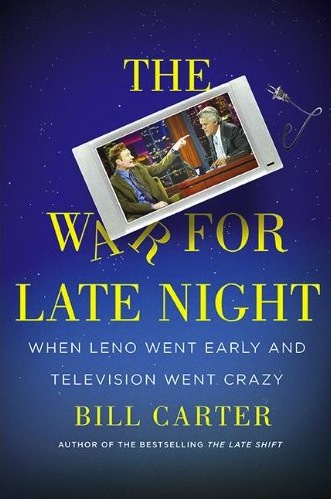
“The War for Late Night” by Bill Carter

Image

With all the hubbub this week re: Jimmy Fallon finally ascending to the role of “Tonight Show” host on NBC, I read Bill Carter’s 2010 chronicle of the last disastrous “Tonight Show” host transition, “The War for Late Night: When Leno Went Early and Television Went Crazy.”  In my mind, it’s the equal of Carter’s earlier book about the late night wars “The Late Shift,” and one of the best books about show business ever written … with an emphasis on “the business” part of that phrase.  It’s a great primer on why “win-win” solutions that look good on paper oftentimes result in disaster.  And it’s the perfect illustration of that old cliche: “You can’t have your cake and eat it too.”

Let’s go down memory lane to the early 2000s… and forgive me if I’m skipping over several key events because I don’t want this to sidetrack my main point:  Jay Leno’s “Tonight Show” was at the top of the ratings for late night talk shows.  However, Conan O’Brien, who hosted the show that came on after the “Tonight Show” (“Late Night”), was scoring bigger ratings among younger viewers, the most prized demographic for advertisers.  It’s the reason why the “Red Skelton Hour” (a Top 10 show) was dropped by CBS in the early 1970s, because the audiences were not the type that brought in big advertising dollars.   Other networks noticed Conan’s appeal among younger viewers  and offered him as much as $20 million a year to leave NBC.  As a result, NBC was desperate to keep Conan. 

At the time, NBC wasn’t about to pay that kind of money to keep Conan (Jay still earned less than $20 million per year), but they had a huge ace up their sleeve:  Conan’s dream of hosting the “Tonight Show” one day.  They did not match what other networks were offering Conan dollar-wise, but agreed to give Conan the “Tonight Show” in 2009, in order to extend his stay at “Late Night” further … with a huge financial penalty (approximately $45 million)  if NBC reneged.  Conan readily agreed.   First problem solved.

Second problem?  What to do about Jay.  Jay was not only scoring the highest ratings in late night, but he genuinely loved his job hosting the “Tonight Show” and most importantly, was in no hurry to leave.  Like Conan, Leno could have made a lot more money going elsewhere (David Letterman’s salary was substantially higher on CBS), but stayed on as the “Tonight Show” host because of his genuine love for the prestige such a gig had.  They told Leno they would extend his contract, but with the agreement in 2009 that he would step down.  The decision hit Jay like a sledgehammer to the gut.  He warily agreed, but started making his resentment clear by making sharp remarks about the situation in his “Tonight Show” monologues and started negotiating behind the scenes to go to another network.

The suits at NBC panicked.  While they wanted to keep Conan, they didn’t want to lose Jay to another network and have Jay potentially come out on top elsewhere.  Their solution?  To give Jay a 10:00 pm show where he could still do his monologue and other comedy bits, but Conan could keep the “Tonight Show.”  Since NBC was in the ratings cellar, moving Jay to 10:00 pm five nights a week, even with paying him more money per year, was substantially cheaper than developing and producing five new dramatic shows.  Plus, since Jay’s audience was skewing older, it made sense at the time to put him in prime time.  The solution first struck both Jay and Conan as unorthodox, but they agreed.   The decision was announced with much fanfare and the NBC suits appeared to be geniuses, averting the ugliness that prevailed in 1993 during the prior “Tonight Show” transition between Johnny Carson and Jay.  Ah … but reality has a funny way of spoiling the best laid plans.

The reality?  Jay’s show bombed at 10:00 pm.  While Jay’s new show was not that radically different than his old “Tonight Show,” it became clear that what works in one time slot may not work well in another. Affiliates were up in arms over the low ratings and threatened to yank the show off their stations.  Conan, on the other hand, was doing merely OK on the “Tonight Show.”  While he was still pulling in the more prized demographic, he was losing in overall viewership to Letterman’s show, which was on top for the first time in several years.  The suits proposed moving Jay’s show to 11:35 pm and moving Conan’s show to 12:05 am.  Jay agreed, but Conan balked.  Yes, Conan would still technically be hosting “Tonight Show,” but it would be on at 12:05 am … rendering the title “Tonight Show” technically meaningless and in Conan’s mind, diminishing the prestige and history of the long-time late night show.

I should point out the fatal flaw Conan’s team made in signing their contract.  While Conan was specifically given the “Tonight Show” in his contract, there was no time-slot protection, a major clause in all major late night host’s contracts.  Which means that NBC could technically stick the “Tonight Show” almost anywhere in the schedule and they would still be in compliance of their contract.  Conan was not pleased with things, but was still mulling things over when NBC made a fatal mistake.  Desperate to get Conan’s thumbs-up before an affiliate’s meeting, NBC head Jeffrey Zucker started playing hardball with Conan’s team. That, plus the fact that Conan’s team was literally the last to know about these plans (even Jimmy Fallon, who took over “Late Night” after Conan went to the “Tonight Show,” knew of this plan before Conan did), finally, in Conan’s words, cured him of his “Tonight Show” addiction.

As we all know, things got extremely ugly amongst all parties involved.  Jay’s fans wondered why Conan would be making such a big deal about doing his show 30 minutes later.  Conan’s fans painted Jay as the Baby Boomer who stayed too long at the party and refused to get off the stage.  And remembering the Machiavellian way Jay … or his management team at the time … beat Letterman for the “Tonight Show” gig in 1993 indicated this was another example of Jay’s treachery.   Conan’s side definitely got the most favorable press at the time and for good reason: Conan was treated abysmally in this situation by NBC and Conan did have a good point about the new plan diminishing the legacy and history of the “Tonight Show.” But objectively, Jay was not the bad guy in this situation either.  As Jay indicated, there was another side to this story: the older guy who’s doing well in his job, but is asked to step aside by the bosses at the top to make way for someone younger.   Jay’s grumblings about going elsewhere during the “lame duck” period between 2005 and 2009 is perfectly understandable.  And NBC trying to find a solution to keep Jay in the fold does make sense, especially since Jay could have potentially done very well going elsewhere.

To be fair to the much maligned Zucker, the initial solution to keep Jay on NBC by giving him a 10:00 pm show was not hastily decided.  The decision did make a lot of sense based on the research they conducted and the network’s financial realities.   And, had both Jay’s and Conan’s shows had more time to work out their bugs and get into a groove, there’s a possibility both shows may eventually would have survived and thrived.   But affiliates were losing viewers and money, and their threatened boycott did not allow enough time for this to happen.

As we all know, a solution was worked out between all parties, but resulted in a lot of bad feelings.  Carter’s account of this debacle  (which includes many other fascinating subplots and characters) is a terrific examination of how pleasing everyone oftentimes leads to pleasing no one. 

 

“Mad as Hell: The Making of ‘Network’ and the Fateful Vision of the Angriest Man in Movies” by Dave Itzkoff

Image

Paddy Chayefsky’s “Network,” a brutally funny and depressing view about American television, is one of the most highly acclaimed (and sadly prescient) satirical films ever made.  Scripted by Chayefsky and directed by Sidney Lumet, it was critically lauded and was also a decent-size box-office hit, a rarity for a satirical film.

Dave Itzkoff’s superlative account of the making of “Network” and its influence on modern news / broadcasting is a wonderfully entertaining read and is recommended for anyone who has an interest in comedy, 1970s Hollywood, broadcast journalism, and Chayefsky.   Itzkoff not only paints detailed backgrounds of all the principals involved, but also quotes many of the actors who had minor but pivotal roles in the film.  Itzkoff’s last chapter deals with the influence of “Network” among broadcast journalists, including some (Glenn Beck, allegedly a huge fan) who seem to have missed the point of the film entirely.

My own feelings about the film are positive, but a little mixed.  In the plus column are the acting performances by Peter Finch, William Holden, Faye Dunaway, Beatrice Straight, Robert Duvall, Ned Beatty and several others.  Also in the plus column is Lumet’s realistic, almost deadpan direction which is the appropriate tone for a movie that gets increasingly outrageous.  And yes, Chayefsky’s script is very good and is justly famous as one of the greatest scripts of all-time.  Chayefsky’s hellish vision of television news devolving into cheap entertainment seemed outrageous in 1976, but is nowhere near as ridiculous as what passes for “news” these days.

However, the problem is also … Chayefsky’s vision.  The film’s strident tone, the shrill manner in which the dialogue is often delivered, and the endless harangues and speeches really grate on the nerves.  Unlike most films, this can’t all be blamed on the director (Lumet), since Chayefsky was the one who insisted on complete creative control (probably one of the only writers who had this much autonomy over what they wrote).  Whatever you don’t like about Spike Lee or Aaron Sorkin (who always deliver their points with a sledgehammer) can be traced directly back to Chayefsky’s script for “Network.”  The most grating character is, ironically, the one who is supposed the be the voice of reason, William Holden’s Max Schumacher.  While I agree with some of the sentiments of what he has to say, the tone comes off as unbearably smug.   I don’t know how much of that is due to the way Holden interpreted the character or what he’s been given to say.  Either way, in the second half of “Network,” Schumacher comes off as pompous and self-righteous and it leaves a bad taste.   I realize I shouldn’t be showing this scene out of the context of the film (I urge you to see it in full and make up your own mind), but it’s the clearest example I can find for why this film doesn’t sit well with me, even thought I admire it very much.

“Superman III” analysis by the “How Did This Get Made?” podcast

Superman III LIVE!

One of my favorite movie podcasts … and so far, the funniest … is “How Did This Get Made?”  The podcast is comedians Paul Scheer, Jason Mantzoukas, and June Diane Raphael (with the occasional additional commentator) discussing the most ridiculous films ever made.  While this is the theme for countless movie podcasts, Scheer, Mantzoukas, and Raphael are actually, really really funny.  And … most importantly … they seem to understand what makes certain bad movies better than others.  It’s not enough to be schlocky.  Being schlocky is easy and in most cases, extremely dull.  But trust me when I say that that it takes a certain kind of genius to make a film as astonishing as “Road House,” “Cool as Ice,” or “The Room.”  They may not be “good” in the conventional sense.  But they’re not boring.  These are very special movies that are positively f–king insane!  

I listened to many of their episodes today and loved what I heard.  But the best of all of them was their dissection of Richard Lester’s 1983 sequel “Superman III” (the one with Richard Pryor).  “Superman III” is not the worst of the Superman films (“Superman IV” makes “Superman III” look like “Pulp Fiction”), but it’s still pretty awful.  I never thought this film was particularly good or even enjoyably bad until Scheer, Mantzoukas, and Raphael (with guest Damon Lindelof) analyzed this film the way scholars analyze “Citizen Kane,” pointing out wild inconsistencies and just flat-out bizarre plot twists that demonstrate that this is truly a much more bats–t crazy film than I remember.  Regardless of whether you agree with their analysis, it’s one of the most hilarious movie reviews I’ve ever experienced … and easily one of the most fun.  The language can be a bit rough, so not safe for work or little ones.