If you follow Dave Strange World, you’ve already heard the story about geeky grunge neighbor circa 1996 who liked to play what sounded like “Ted Bundy and Hitchhiker” with his goth girlfriend at all hours of the night … the the point where I had to drown them out with Sonic Youth’s “Daydream Nation” in another room in order to sleep. If you haven’t, then here’s the link:
But that’s not the only story about bizarre and annoying neighbors from that year. Upstairs from me were a group of other memorable neighbors …
There was what (I think) were a group of girls that were probably not college students, but likely had just graduated from high school. They were hideously unattractive, always wore jeans and tie-dyed shirts, and were always running up and down the balcony of the apartment complex laughing loudly and hysterically. I called them “The Manson Girls” because they always had that scary “laughing to disarm you because I’m about ready to stab you to death and write on the wall with your blood” type of air about them. One night, I saw them with multiple road signs (obviously stolen), screaming and laughing and running to their apartment upstairs. Another night … notably the first night I cooked dinner for my now wife of 15+ years … I had my windows open, because it was a very warm night and I had trouble opening a bottle of wine. The cork exploded loudly and then the “Manson Girls” came bursting into my apartment … giggling manically, as if they were joining a massive party already in progress … and begging me for money. Flabbergasted, I told them “F–K NO!” and to “Get the f–k out of my apartment!” Later, I felt self-conscious, and asked my future wife if I was too d–kish in my reaction (it was our 5th date, after all), but I seriously felt violated by these crazy people. I never had any interaction with them again … but later that summer, the lighbulb outside of my apartment was stolen. I’m not pointing fingers, but I place the blame on this with the Manson Girls. Seriously, a freakin’ lightbulb was 89 cents in 1996 dollars … and these future “guests of the state” I’m positive stole my light bulb.
There are many comedians with jaw-dropping Sam Kinison stories. And, trust me, ALL of these stories are jaw-dropping, because Sam, let’s be honest, was a total f–king maniac. But this story by Ralphie May is particularly funny, especially because he was only 17 at the time. This is one of my favorite stand-up crash-and-burn stories of all time. God bless Sam … and God bless Ralphie May, for that matter. Ralphie May has edged out a VERY VERY funny stand-up career in the years since.
This is the (in)famous live version of Van Morrison’s “Cyprus Avenue” from the concert that was recorded for the legendary “It’s Too Late to Stop Now” live album in 1974.
The original “Cyprus Avenue” from 1967’s “Astral Weeks” was a beautiful and wounded song about a man desperately in love with someone, but who can’t express himself to tell this person he loves her. The problem, you see, is that he’s a grown man and the person he’s in love with is a very, very young girl. And he’s “conquered in a car seat,” staring at her walking to school … Mmmkay … Despite the creepy subject matter, this is a great song, but I can’t say that it doesn’t also turn my stomach a bit. It’s a good thing Perverted Justice and Chris Hanson from Dateline NBC were not around in 1967 for Van’s sake.
Anyway, let’s cut to 1973 … Van is performing this song live. But Van is in full James Brown mode. And holy … f–king … s–t … does he give this solemn, sad song the full James Brown treatment! And it is one of the most amazing musical performances I’ve ever seen. Many people seem to only know the Van Morrison of “Moondance” and the corny “Have I Told You Lately That I Love You?” phase of his career. But they forget that Van started out in the Irish garage punk band Them … or that the first version of “Madame George” (a sad song about an aging transvestite, also recorded for “Astral Weeks”) was originally a raunchy, nasty punk blues stomp recorded for the album “T.B. Sheets.” Believe it or not, before he became the Irish mystic troubadour, Van used to kick out the f–king jams. And this legendary performance of “Cyprus Avenue” proves it.
I heard this amazing insight writer/director/producer Judd Apatow had about his own neuroses on Marc Maron’s extraordinary WTF podcast from 2011. Maron asked him why they don’t feel any sense of joy and Apatow’s answer made perfect sense to me. What’s missing from the transcript below is hearing Apatow and Maron both laughing their asses off as Apatow is explaining this. And damn if I wasn’t laughing as well… for reasons that are obvious if you know me…
Marc Maron: Why are we so afraid of joy?
Judd Apatow: That’s the question, and I’ve thought about it a lot. And I think it’s because we think that right behind joy is a knife that will cut our throat. And if we feel it, it’s almost like a laugh, and you’re chin goes up, and you’re throat is exposed. And if I laugh too loud, someone will slit my throat. And so, that’s the terror of joy. If I enjoy this as completely as I want to, it’s gonna hurt when it goes wrong. And the mistake is, it hurts already. Keeping shut down is what really hurts. And so it doesn’t actually make sense, and if you have to think about it all the time to know that’s what’s happening. Like I’m not actually enjoying this. And then you’re not present because you’re waiting for a punch. That’s how I feel like. I feel like I have my dukes up all day long, looking for someone who’s going to punch me, and here’s the thing: no one ever punches me.”
P.S. You’re not allowed to say “That’s OK Dave, I’ll punch you” in response … Not because it’s not funny, but because I’ve already thought of it.
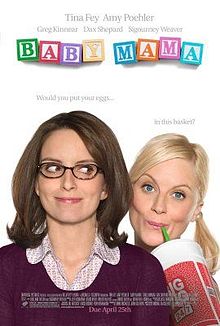
First off, some major disclaimers. I normally don’t talk about things I dislike on this blog. And to be fair, the 2008 film “Baby Mama” is far from being the worst film I’ve ever seen. It seriously doesn’t warrant the words I’m about to say about it. But “Baba Mama” represents everything I hate about many movies, let alone TV. And, more significantly, it also represents why I decided to do what I do with my blog.
“Baby Mama” is not a significant film. It was not intended to win Oscars or blow minds. I could be wrong, but I seriously doubt it was even conceived with the notion that it would make a dent … at all … in the psyches of the general public. At best, it was designed to be a lightly funny diversion for people on a Friday night after a hard work week, with the mere intention to amuse. If it amused any of you, that’s cool with me. My last goal is to piss on any text that brought genuine joy to someone in any capacity.
But this film offended me … enraged me, even. And not because it was a terrible movie. But because “Baby Mama” was so painfully mediocre. The film would have actually been better had it been terrible. Because at least I would have found something interesting about it. Aside from one funny joke about whether a brown stain on a finger was poop or chocolate, absolutely NOTHING about this film made me laugh, let alone smile. For me, it was the equivalent of watching the TV shows “Two and a Half Men” or “Wings.” Or the movie equivalent of eating a Burger King breakfast sandwich. It wasn’t good. It wasn’t terrible. The experience of watching “Baby Mama” meant absolutely … f–king … nothing. It was a void.
Where does one place the blame for a film like this? Is it the cast? I don’t know. I can say with all honesty that I genuinely like all of the major actors in this film (Tina Fey, Amy Poehler, Greg Kinnear, Dax Shepard, Sigourney Weaver, Steve Martin). I’m sure none of these talented people chose to do this because the script they read completely sucked. I realize creative people do some things for the money. But all of these people could have found a job doing something else if they didn’t find the project genuinely interesting.
The next suspect: the writer / director Michael McCullers. This was (and as far as I know) the only film McCullers has directed, after writing credits on three “Austin Powers” films. I’m sure he wasn’t expecting his first film to be “Citizen Kane,” but I think he probably thought this wouldn’t be a bad film to make his directorial debut on, considering that Lorne Michaels was a producer. And you know what? The film was competently made. I didn’t see any glaring Ed Wood-style screw-ups. Was it the script? The “Austin Powers” films he helped write were huge hits and … to varying degrees … pretty funny. Talented people can strike out creatively, but the fact that all of these talented people lined up behind it makes me think that maybe the original script had more going on with it than what resulted in the final product. Especially when you consider that most major studio comedies go through a hellish “rewriting” process where as many as 20 anonymous writers may be hired to “punch up” the script to make it “funnier,” though in most cases, whatever original spark the script had has been beaten to death or taken out entirely.
So who’s to blame for how lame the final product is? I don’t know. And I’m not the one to point fingers. Based on what I know about how movies are really made, the creation of “Baby Mama” was likely a classic example of a film run through the “machine” of a major corporate studio thinking more about “demographics” and “ancillary markets” than producing something of quality. But then again, who knows? All I know is that I didn’t have high expectations when I checked this DVD out of the library, other than to find something kind of funny and not too deep to watch for the end of a work week. And what I saw was absolutely lacking of my, admittedly, minimal expectations.
Which leads me back to why I do this blog. I’m not a film critic or movie reviewer, but I think I can say what I dislike about a film (or other text) in an intelligent manner. However, auteur theory be damned, most movies are not the result of one creative power. There are many people responsible for the creation of a film and to pinpoint what makes a particular film bad is typically based on which person behind the scenes can provide the most persuasive argument. I’m not in the industry, let alone an insider who can intelligently say what made a major film get greenlit or why it went artistically astray. All I know is what makes me laugh … turns me on … blows my mind … or make me question my existence. And because I’m in my 40s and don’t know whether I have 2/3, 1/2, 1/3, or (yikes!) even less of my life left to live, I’d rather talk about those things I like in detail, than analyze things I dislike.
I’ve been doing this blogging thing for roughly a year now. Dave’s Strange World has only been active approximately 9 months, but that’s only because my original blog (Dave’s Waste of Time) got unceremoniously yanked after 3 months to same vague violation of the “Terms of Agreement” … or something of that nature. My blog may be a lot of “happy happy” talk about “great” or “awesome” or “terrific” things (I probably need a better thesaurus), but again, I’d rather talk about things that move me, than things that make me go “eh.”
Please note that anyone who has put their heart and soul into putting together something creatively, no matter how disagreeable I may find the final product, is far ballsier than I could ever imagine to be. So even if I don’t like your creative endeavor, you get a pass from me for putting yourself on the line for doing far more than I’ve ever done. And if you’re making people happy, then screw all of those people, including myself, who try to ruin your parade.
One of the most pleasant acting surprises of the last several years was Sir Ben Kingsley’s turn as psychotic gangster Don Logan in Jonathan Glazer’s brilliant British gangster film “Sexy Beast.” Who would have thought that Kingsley, the master of playing sedate, thoughtful, mature characters would let his freak flag fly so blatantly … and excessively? Seriously, in a battle between Kingsley’s “Don Logan” and Jo Pesci’s “Tommy” in “Goodfellas,” I might give the edge to Kingsley. Maybe the bald pate makes him look more intense, but Kingsley looks like a rabid f–king dog in “Sexy Beast.” As much as I love Jim Broadbent, Kingsley DESERVED that freakin’ Oscar in 2001 for “Sexy Beast.” Or at the very least, Broadbent should have offered it to him. Because the f–king insane rage Kingsley brought to that part comes from somewhere. And I wouldn’t want to cross him in a dark alley.
This is one of the many moving scenes from P.T. Anderson’s magnificent 1999 film “Magnolia.” This is the first date between John C. Reilly’s decent police officer character Jim and Melora Walters’ troubled Claudia character. This event occurs about 2/3 of the way into the film. Jim is a very good, compassionate man who feels tremendous guilt over losing his gun on the job. Claudia is a promiscuous drug addict trying to blot out an abusive childhood. On the grand scale of things, Jim’s troubles are far less severe than Claudia’s … but somehow, they seem to be meeting at the right time in the right place in their lives. Nobody in their right mind would EVER have a first date like this … but as we all know … if we’re lucky … we know that life is strange. And sometimes fate compels you to act in ways that you otherwise wouldn’t … because you have a strange hunch that the person you happened to just meet and sitting across from could potentially change your life for the better. Granted, a lot of people choose this path and wind up with someone who is a complete disaster. But sometimes it goes the other way, too.
This scene always brings a lump to my throat and is one of the best scenes in a film that I consider one of the best of the 1990s.
A lot of people … especially a lot of creative and/or famous types … characterize their teen years as the most painful, horrific time in their lives. I understand this to a certain extent, because it gives their life story a cinematic “Rocky”-esque sense of triumph for whatever success they’ve eked out. But this wasn’t my experience. My teen years weren’t a bed of roses, but they weren’t terrible either. I wasn’t “popular” per se, but I wasn’t unpopular. I wasn’t an object of lust, but I remember a few not unattractive girls giving me hints that they may have liked me-liked me (the fact that I didn’t figure this out until years later is the tragic part of that story). Some people were d–ks to me on occasion, but overall, I wasn’t picked on or harassed. I had friends in different cliques and while I wasn’t a part of any of them, I didn’t feel like I was crashing any party by associating with them. My high school experience was about as average (and as healthy) as one could expect.
My early 20s were a different story. They didn’t completely suck, but my early 20s were, for the most part, a really f–king painful and horrible time. I think one’s 20s are arguably different than one’s teen years. Because when you’re a teenager, as much as things suck, you have a great sense of hope. You haven’t made any mistakes yet. You have the safety net of your parents, friends, hometown, etc. There’s a lot of potential that hasn’t been tapped or realized. In your teens, nothing is expected of you, other than to make decent grades, not get into too much trouble, and to be on a path to eventually become a productive member of society.
On the other hand, your early 20s (especially your post-college years) are when you actually have to deliver on that stuff. You’re either on your own … struggling to make rent / car / student loan payments and having “relationships” with people who are just as confused and conflicted as you are … or you’re back living at home, trying to do the same thing. Neither scenario is conducive to any sense of self-esteem, though the latter scenario is arguably, worse.
If you’re a guy, unless you’ve got some cool job, you have a cool post-graduate field of study (medicine, law, MBA), or you’re still attached to a college sweetheart, your dating life will suck. Most of the unattached single gals your age are typically dating older guys who have established themselves in some respect (For the young guys who want to feel some misguided, but vaguely misogynistic “revenge” for this scenario, the pyramid does invert when you get older … provided you’ve … well .. established yourself in some capacity. If you’re still living with Mom at age 33, let’s just say that you’re going to have to work a bit harder to be considered a “chick magnet”). To be entirely honest and fair about my post-collegiate drought, I can’t say that I was much of a catch in those days. Now that I’m in my more world-weary early 40s, I can say with confidence that most guys in their early 20s are more than a little douchey.
Anyway, the entire reason I bring this up is that this song by Green Day, released during the time of my greatest angst circa 1994, just about epitomizes the malaise of the first half of my early 20s. I’m also curious if other people feel the same way as I do about their 20s … or if they felt their teenage years sucked more. I don’t think I’m an authority by any means, but I do wonder, especially since so many people feel their teen years are the worst years of their lives.
P.S. The latter half of my 20s went considerably better. But that’s another story.
The second 9-minute plus mini-rock opera featured on Green Day’s 2004 rock opera “American Idiot.” Arguably, given the sound and thematics of this song, this should have been the last song on the album. But perversely, it was the next-to-the-last song on the album. This isn’t as mindblowingly terrific as the other mini-rock opera “Jesus of Suburbia,” but what’s here is still damn impressive. I especially like Tre Cool’s “Rocky Horror Picture Show”-style riff about 5:23 into the song, sung from the perspective of a jaded rock star… with saxophones even … For better or worse, this is a band that truly studied its rock history before composing and recording this album. I’d say it’s for the better. I love the nods to the past while raging on into the future. I love the “American Idiot” album more and more each year.
Michael Cimino is one of the greatest crash-and-burn tales in Hollywood history. Cimino was someone who had bounced around Hollywood for years until he wrote and directed a Clint Eastwood hit (“Thunderbolt and Lightfoot”) in 1974. Based off that, he got the opportunity to make a more personal project … in this case, “The Deer Hunter.”
“The Deer Hunter” was based on a script that originally had nothing to do with the Vietnam War called “The Man Who Came to Play” (written by Louis Garfinkle and Quinn K. Redeker) which was about Vegas and Russian Roulette. Cimino had the script rewritten and placed the setting in Vietnam (the final screenplay was credited to Deric Washburn).
While “The Deer Hunter” went overschedule and overbudget, it still beat Francis Ford Coppola’s troubled and long-gestating Vietnam epic “Apocalypse Now” to the screen by approximately 9 months. So “The Deer Hunter,” by default, became THE first major studio film about the Vietnam War, post-Vietnam War. As a result, everyone expected (and treated) this film as a definitive statement on the Vietnam War, if only because there were no other films out there at the time about the subject.
If you see “The Deer Hunter” as a statement about the Vietnam War, the film will sadly come up short. I don’t see “The Deer Hunter” making ANY statement about the Vietnam War … at all. Now that there have been several films about the Vietnam War that have since been released, I think “The Deer Hunter” can be seen more objectively as a film about three friends who suffer a collective traumatic event and come back changed in irreparable ways.
There may be nothing to document that the infamous Russian Roulette scenes that took place in the film actually happend. But I don’t think the inclusion of these scenes says anything about the Vietnamese people or the Vietnam war. War in general is a messy, messy thing. Atrocities are committed on all sides in a war and not everyone plays fair or according to the rules of the Geneva Convention, Were all Vietcong soldiers sadistic, evil bastards who committed atrocities on American soldiers? No. Were all American soldiers sadistic, evil bastards who committed atrocities on the Vietnamese? No. Were there bad elements on both sides that committed atrocities who saw the war as an excuse to express their darkest sides? Absolutely.
Which is why, in retrospect, I can view “The Deer Hunter” less a statement about Vietnam, than what happens to three friends who suffer through a horrible tragedy and how it affects them. In my mind, the film could have removed the Vietnam element entirely and focused on another traumatic event (i.e. the one in “Deliverance”) and still have packed the same emotional and visceral punch. The use of Vietnam may have (arguably) been a cynical use of a real event for dramatic purposes. But to criticize Cimino for using Vietnam in his story is like criticizing Shakespeare for exploiting real events in several of his plays (“Julius Ceasar,” “Henry IV”). Not that I’m comparing Cimino to Shakespeare …
“The Deer Hunter” is, admittedly, a difficult film. It’s very long, has several disturbing and upsetting scenes, and is not what we conventionally see as a coherent text. But even 35 years later, it’s still an amazingly powerful film that is gut-wrenching to watch. The performances by Robert DeNiro, Christopher Walken, John Savage, Meryl Streep, and John Cazale are amazing. The cinematography by Vilmos Zsigmond is stunning. It’s still incredible that a film like this would have won a Best Picture Oscar, but it is truly deserving.
This film might still be celebrated today … if not for the fact that Cimino’s next film, “Heaven’s Gate,” was such a colossal critical and commercial flop. While many cineastes (including myself) can argue the virtues of “Heaven’s Gate,” it’s failure tainted the success of “The Deer Hunter” … to the point where several critics reversed their own opinions on “The Deer Hunter” to say that the emperor wore no clothes (Vincent Canby of the New York Times being the most notorious example). Which asks the question: “Did the critics really even love ‘The Deer Hunter’ or did they just jump on the bandwagon of praise? And by the same token, did they jump off when people turned against Cimino?”
To figure out this quandary is a useless party trick, in my opinion. While there are many parts of “Heaven’s Gate” that I admire, I still find the film severely flawed. Having said that, this doesn’t negate my appreciation of “The Deer Hunter” at all. It’s a film that never ceases to shock, amaze, and move me and is one of the best films I’ve ever seen.
I remember seeing this film for the first time on an independent over-the-air TV station uncut around 1982 or so. The film was sold to the CBS network for $5 million. But allegedly, when they discovered that they couldn’t edit this film in an adequate way, they gave up on trying to show it. The studio (Universal Pictures in the U.S.) sold the film to independent stations who showed the film uncut in two parts. All of the language, nudity, and violence was on full-display. And to best of my knowledge, there were no FCC complaints. Compare that to the ABC network’s decision to show Steven Spielberg’s “Saving Private Ryan” uncut in the early 2000s and not only did complaints flood into the FCC, but ABC was fined hundreds of thousands of dollars for showing it this way. I like “Saving Private Ryan” a lot, but even though it’s more graphically violent than “The Deer Hunter,” it’s arguably much less controversial. The times have indeed changed.

 Dave's Strange World