“Flooding with Love for the Kid” (2010) dir. Zachary Oberzan

Video

Artists typically fall into two categories: dreamers and doers. While it’s important to have a dream, it doesn’t mean anything if it just stays inside your head. Zachary Oberzan is a doer.

Oberzan saw the movie “First Blood” back in the early 1980s. “First Blood” is the Sylvester Stallone Rambo film most critics call “the good one.” Oberzan was such a fan of “First Blood,” he picked up the David Morrell novel on which the movie was based and was blown away even more. The novel, far more complex and nuanced from the resulting film, gave Oberzan the dream to one day make a more faithful adaptation of Morrell’s original book.

Unfortunately, since the Rambo series took on a much different tone with the second film (where Rambo rescues POWs from Vietnam), a tone that proved to be very popular with 1980s era audiences, there was not much hope someone would ever do a more faithful remake of the original book.

Normally someone with Oberzan’s dream would try to wrangle the rights away from the copyright holders, convince financiers to invest several millions of dollars, find bankable actors to carry the movie, find a distributor, and then release the film. Even when said process runs smoothly, it can take several years, and oftentimes the end result is a film that’s never released, let alone made.

Oberzan said “F–k all that!” and just did it himself … in his 220 square foot New York City apartment … with a home video camera … and a total budget of $96. Oberzan not only wrote, directed, shot, and edited his adaptation, but also performed all of the acting roles. The result is one of the most compelling films I’ve ever seen.

On first glance (especially from the trailer), Oberzan’s adaptation, called “Flooding with Love for the Kid,” seems completely insane and ridiculous, like Ed Wood directing the Max Fischer players from “Rushmore.” However, once you get over the shock over how the film looks and plays, you start to pay attention … and then you find yourself riveted.

This will likely never wind up on anyone’s list of greatest films ever made. But Oberzan, using tools most of us have access to … but would never use … even if some of us filmmaking dreams, made a completely fascinating and exciting feature length film. He does such a great job with what he had to work with, it makes you wonder what he could do with a bigger budget and better tools. Oberzan is not only someone to watch, but his story is an inspiration to artists everywhere.

If you’re interested, check out Oberzan’s website which provides more details on how you can order the film:

http://www.zacharyoberzan.com/title.html

“Exploding the Phone: The Untold Story of the Teenagers and Outlaws who Hacked Ma Bell” by Phil Lapsley

Image

Before Napster, before computer hacking, and even before the VCR, there were “phone phreaks.”  What, pray tell, are phone preaks?  The phone phreaks were a group of individuals back in the 1960s who figured out a way to make free long distance calls through manipulating the flaws in Bell Telephone’s and AT&T’s extensive national network of phone lines.   The tale of how many distinct and different individuals made their own “blue boxes” and “black boxes” to make phone calls is chronicled extensively in Phil Lapsley’s extremely entertaining new book “Exploding the Phone: The Untold Story of the Teenagers and Outlaws who Hacked Ma Bell.”

While Lapsley does go into extensive technical detail about how the different hackers learned to circumvent the system to make free phone calls, it’s never too much that you still won’t be riveted by the story.  The phone company went into a panic for obvious reasons, not only because their system which they spent billions creating was flawed and could lose them money due to hackers figuring out their system, but because the laws at the time didn’t expressly make such hacking illegal.  And, most tellingly, because the Justice Department and FCC at the time didn’t agree that current laws should be interpreted to prosecute such activity.  Hard to believe, but there was a time when the government was not quite the pathetic bitch to corporations as they are today.

“Exploding the Phone” is a fascinating cultural history of technology, law, and business and is especially relevant, given how this story seems to be repeated every time ordinary people figure out ways to exploit flaws in technology.

2000 Hits on Dave’s Strange World!

Video

Dave’s Strange World just had it’s 2,000th view today. Many thanks to everyone, from followers to lurkers, for the continued success of this blog.

To celebrate, esteemed British actor Oliver Reed has agreed to come back from the grave to do a solo performance of what dance purists call “Drunk on Aspel.”

The all-time Top 10 most popular posts on Dave’s Strange World:

10. “Copendium” written by Julian Cope

9. “Mother” – Natalie Maines (with Fred Norris) live on the Howard Stern Show 1-4-2013

8. “The Rebel Jesus” – Jackson Browne and the Chieftains

7. “Spirit of Truth aka One Man Show” (1997) – Vincent Stewart as Reverend X

6. “Hard Working Man” – Captain Beefheart / Ry Cooder / Jack Nitzche, from the film “Blue Collar” (1978) dir. Paul Schrader

5. “Russ Meyer’s Vixen” (1968) dir. Russ Meyer

4. “Saturday Night Live 1980″ – Nathan Rabin’s “How Bad Can it Be? Case File #23″

3. “Poetic License is Not Appreciated” a look at “American Me” (1992) dir. Edward James Olmos and “Blood In, Blood Out” (1993) dir. Taylor Hackford

2. “Everything is an Afterthought: The Life and Writings of Paul Nelson” by Kevin Avery

and still #1 with a bazooka …

1. “The Girl You Wish You Hadn’t Started a Conversation With At A Party” … From Saturday Night Live (2012)

“Copendium” written by Julian Cope

Image

Many people remember Julian Cope for his mid-1980s solo hit “World Shut Your Mouth” or his stint as lead singer for the post-punk band The Teardrop Explodes.  In recent years, however, Cope has built a formidable reputation as a writer on all matter of subjects, most notably music and antiquities.  His overview of Krautrock (1960s-1970s German psychedelic rock) from 1995, “Krautrocksampler” is considered a classic, even though he refuses to have it republished because of factual errors he’s since discovered and because he claims there are others more knowledgeable than he is.  His antiquities books “The Modern Antiquarian” and “The Megalithic European” have also proven to be very popular.

Cope’s latest book “Copendium” is a massive collection of essays (over 700 pages) culled from Cope’s website that chronicles terrific, but ignored or forgotten music albums, spanning several different genres.  Among the artists that Cope exhaustively writes about: Von LMO, The Electric Eels, Montrose, Pentagram … even a Van Halen bootleg gets a detailed essay.  If you love discovering new music and enjoy great writing, “Copendium” is damn near perfect.

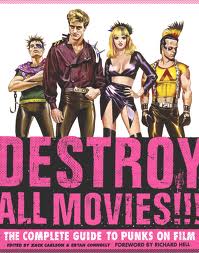
“Destroy All Movies: The Complete Guide to Punks on Film” written by Zack Carlson and Bryan Connolly

Image

This came out a couple of years ago, but I still haven’t completely absorbed all 463 pages of it yet.  This, my friends, is the definitive and most exhaustive look at punk rock on film ever created.  Carlson and Connolly reportedly spent 10 years putting this massive tome together.  The concept?  Watching and reviewing every film between 1975 and 2000 that not only had punk rock as its subject matter, but also every single film where someone who looked even remotely punk appeared.  Blessed with the ability to rent videos for free from Seattle’s Scarecrow Video (the best video store in the world!) over the course of this project, Carlson and Connolly watched … and watched … and watched … literally thousands of films … all for the sake of proper documentation of this important subculture on celluloid.  Even the publisher (Seattle’s esteemed Fantagraphics) reportedly thought they were nuts, but fortunately had the gumption and foresight to see this project through.  Even if you don’t like punk rock, this punkopedia is ridiculously entertaining from start to finish.  However, it doesn’t look like it’s currently in print, based on the high cost of copies on Amazon.  Fantagraphics:  please republish this or at least, put out a Kindle version for those who love to browse this tome, but don’t have the luggage to carry this coffee table size book with them while they’re out and about.

Be sure to hear the entertaining interviews with Carlson and Connolly that appeared on the terrific “The Gentleman’s Guide to Midnite Cinema” Podcast for more details:

http://ggtmc.libsyn.com/bonus_12_interview_with_zack_carlson

http://ggtmc.libsyn.com/bonus-29-interview-with-brian-connolly

Joe Eszterhas on Mel Gibson (Howard Stern Show, 6-27-2012)

Video

A great interview with legendary screenwriter Joe Eszterhas by Howard Stern from June 2012, focusing on Eszterhas’s disastrous collaboration with Mel Gibson. Pretty funny in a lot of spots, but also a fairly disturbing look at Gibson. If you’re interest is piqued, you seriously need to read the Amazon Kindle single “Heaven and Mel”which goes into much more detail. It’s the length of a 150 page book, but it’s only $2.99. One of the most harrowing and hair-raising True Hollywood Stories you’ll ever read. To be fair, aside from Mel’s minor rebuttals, we haven’t heard Mel’s complete side of the story. However, Eszterhas does make a good case and rightly or wrongly, as Mike Ovitz learned, “Don’t f–k with Eszterhas!”

Lots of bad language and adult subject matter so not safe for work or little ones.

“Our Band Could Be Your Life: Scenes from the American Indie Underground 1981-1991” written by Michael Azerrad

One of the best music books of the last 10-15 years is Michael Azerrad’s history of American alternative rock from 1981-1991, “Our Band Could Be Your Life.”  Released in 2001 and available in digital format within the next day or so, “Life” is the college radio version of “Easy Riders, Raging Bulls” (Peter Biskind’s exhaustive and stellar look at Hollywood of the 1970s).  Azerrad devotes each chapter to a different seminal band of the period (Mission of Burma, Butthole Surfers, The Minutemen, Sonic Youth, Black Flag, Big Black, Hüsker Dü, Fugazi, Minor Threat, Mudhoney, The Replacements, Beat Happening, and Dinosaur Jr.).  Some of the stories you may know … others you won’t.  But if you have any interest at all in rock history (especially alternative / progressive rock), “Life” is a must.  The chapter on the Butthole Surfers by itself is worth the price of the entire book.  Seriously, the chapter reads like Hunter S. Thompson smoking angel dust with Monty Python with chaos, insanity, humor, and violence ensuing like a motherf–ker!

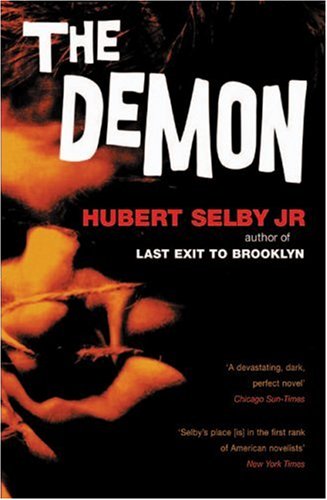
“The Demon” by Hubert Selby Jr.

Sex addiction is sort of taken seriously these days, but too often, it’s either thought of as a failure of morality or mindlessly celebrated as “transgressive.”   I don’t believe Hubert Selby Jr. was ever a sex addict, but sex addiction follows similar patterns of other addictive behaviors, whether it’s drug abuse, shopping to the point of bankruptcy, hoarding, overeating, etc.  Addiction is a compulsion to do the same behavior over and over again to satisfy some undefined need that’s never fulfilled.  It can be a very scary and dark place.  Selby understood this and had the foresight to write one of the first pieces of fiction that took this compulsion very seriously.

Written in 1976, “The Demon” is about a man named Harry who is a rising star on the corporate ladder, except his addiction to anonymous hook-ups consistently threatens to derail his career, his marriage, his sanity, his freedom, and his life.  The book chronicles roughly 15 years Harry’s life from his early 20s until his late 30s and shows his struggles.  It’s an explicit book, but not in the way you would expect (especially from Selby). Instead of describing Harry’s sexual hook-ups explicitly, it instead graphically describes the inner demons raging within him before a hook-up … the twitching, the sweating, the rationalizing, and finally the surrender to his compulsions.   He tries substituting other things for his addiction (i.e. he becomes obsessed with collecting plants), but always succumbs to the monkey on his back.  The book takes some very dark turns.  I can’t say there’s a happy ending.

If my synopsis makes “The Demon” sound like some hysterical, religious-inflected “Reefer Madness”-style look at sex addiction, it’s only because of my limitations as a writer.  “The Demon” is a great, but very dark hell-ride into the inner hell of compulsive behavior.  The fact that this was written during the height of the sexual revolution (the original book was published by Playboy Press) is especially ballsy on Selby’s part and being a recovering addict himself, had an insight into a compulsive behavior many didn’t (and still don’t) take seriously.   A truly terrific, scary, and underrated book that many people don’t know about (“Last Exit to Brooklyn” and “Requiem for a Dream” being Selby’s most famous works).

“Everything is an Afterthought: The Life and Writings of Paul Nelson” by Kevin Avery

One of the best books I’ve read this year is Kevin Avery’s biography / anthology of rock writer Paul Nelson, called “Everything is an Afterthought: The Life and Writings of Paul Nelson”.  Most people have no idea who Nelson was, but he was an integral part of rock history between the 1960s and 1980s.  He knew Bob Dylan when he was still Robert Zimmerman at the University of Minnesota and introduced Dylan/Zimmerman to a lot of rare folk recordings that wound up being Dylan staples.  He was also one of the few folk critics at the time who supported Dylan’s move to rock in the mid-1960s.  He worked for Mercury Records in the early 1970s, and Nelson was not only Rod Stewart’s favorite Mercury employee (Stewart was Mercury’s biggest star at that time), but Nelson also signed the New York Dolls.  As a critic for Rolling Stone, he also championed Bruce Springsteen, the Sex Pistols, and the Ramones early in their careers.   He also wrote about and became friends with Jackson Browne, Warren Zevon, and Clint Eastwood.   In the early 1980s, he drifted away from his career as a writer/editor and had difficulty meeting deadlines or completing articles.  He worked at a video store during the last years of his life and then gradually lost touch with reality.  He died penniless and alone, a sad end to a brilliant career.

“Everything is an Afterthought” is a loving tribute to a writer who deserved bigger and better success than his demons would allow.   It’s clear from the testimonials and interviews given for this book how loved Nelson was by his colleagues and friends (i.e. Nick Tosches, Greil Marcus, Dave Marsh, Jonathan Lethem).  Special thanks to Avery, as well as Seattle’s Fantagraphics Books for having the vision and passion to bring us this story.