“Louie Louie” – Iggy and the Stooges

Video

The most notorious live album of all-time “Metallic K.O.” was recorded 40 years years ago today. As a selling point back in the day, it was said you could hear beer bottles smashing against guitar strings. By this point, Iggy and the Stooges had worn out all of their good will and were drowning in a sea of heroin, booze, and “not playing nicely with others.” They were openly hostile with audiences and baiting them to beat the crap out of them …which often happened. Here’s the most infamous track from that legendary album. And, most importantly, Iggy is still alive to celebrate this milestone.

“This Little Girl” by Gary U.S. Bonds

Video

If you listen to 80s stations, you’d think there were only 200 songs recorded during that decade. As much as I love “Come on Eileen,” “Tainted Love,” “Hungry Like the Wolf,” or “Billie Jean,” I’m totally burned out on these handful of hits. Which I why when I listen to 80s stations nowadays, I tend to listen to the Top 40 countdowns for a particular week during some random year in that decade. Here is where you get to hear a lot of songs that were hits, but for whatever reason, are shut out of the very tight programming of such stations. Some of these rarely played songs are terrible … some of them are great. “This Little Girl” by Gary U.S. Bonds is one of the great ones.

Gary U.S. Bonds was a rocker from the early 1960s who had a lot of seminal hits back in the day (“New Orleans,” “Quarter to Three”) and then faded away until Bruce Springsteen and the E. Street Band resurrected Bonds in 1981 with a hit album (“Dedication”) and this gem that made it all the way to #11 on the Billboard charts that year.

I don’t know about you, but where I lived at the time (Tidewater, VA area), you could not escape this song that year. This song was EVERYWHERE and then after a year, I never heard it again … until I happened upon one of those Top 40 countdown shows that replayed the most popular songs for a particular week in 1981. A great, great song that should be in heavy rotation on these 80s stations, but sadly isn’t.

“What Would Brian Boitano Do?” – DVDA

Video

In honor of the current Winter Olympics in Sochi, here’s the band DVDA doing a version of “What Would Brian Boitano Do?” from “South Park: Bigger, Longer, and Uncut.” I don’t know whether to bang my head, start a fight, dance a jig, or do all three.

If you don’t know what the term “DVDA” means, you’ll have to look this up on Wikipedia. I mean, you’ll go to hell if you do, but it’s there if you follow Sam Kinison’s attitude of “My view of life is, ‘If you’re going to miss Heaven, why miss it by two inches?'”

“Teenage Rampage” – Sweet

Video

My all-time favorite song from Sweet. Yes, the clothes and makeup are f–king ridiculous. But the 1970s glitter rock era produced a lot of great music. If the visuals bother you, just listen to the music. This is crunchy hard rock with pop hooks, not that far removed from the Sex Pistols which came two years later. It’s music you can bang your head and sing along to.

“Puddy Cat” – Wade Curtiss

Video

Unquestionably, this is one of the most f–ked up songs ever recorded. It’s a “cover” of the Trashmen’s legendary trash-rock classic “Surfin’ Bird,” only Wade Curtiss substitutes lyrics about a cat. I have no idea what Curtiss was on when he recorded this. But trust me, it’s something I want to avoid like the ebola virus.

Joe Bob Briggs commentary for the “I Spit on Your Grave” DVD/Blu-Ray

For better or worse, Roger Ebert influenced me more as a film commentator and fan than any other writer.  What I liked … and still like … about Ebert was his ability to find merit in many films other critics found disreputable, specifically those that may contain extensive sex and/or violence.  Ebert was one of the first major critics to find merit in the films of Russ Meyer at a time when Meyer was reviled as a pornographer by … pretty much everyone.  Meyer returned the favor by hiring Ebert to write the script for “Beyond the Valley of the Dolls,” Meyer’s big-studio X-rated debut film, along with Meyer’s future films “Supervixens” and “Beneath the Valley of the Ultra-Vixens.”

Despite this, however, Ebert could be uncharacteristically persnickety about certain controversial films that one would think he would embrace.  David Lynch’s “Blue Velvet” is probably the most notorious of his slams.  But his review of the notorious 1978 rape and revenge film “I Spit on Your Grave” is almost equally famous.  Not because “I Spit on Your Grave” is a particularly good film.  But because Ebert said these things: “Attending it was one of the most depressing experiences of, my life” and also ended his review by saying “At the film’s end I walked out of the theater quickly, feeling unclean, ashamed and depressed.”

A lot of things can influence one’s opinions of a film that have nothing to do with the film … one’s mood on the day they see the film, the venue in which once sees the film, the audience the film is seen with, etc.  However, Ebert’s fevered reaction to “I Spit on Your Grave” was particularly memorable … and strange.  Mainly because Ebert gave a good review to an equally notorious rape and revenge film of the early 1970s … Wes Craven’s “Last House on the Left.”   Ebert made a point of using “Grave” as an example of the “worst of the worst” during his tirade about “slasher films” during the early 1980s.

While “I Spit on Your Grave” is not a great film, it’s not completely without merit.  Hearing Joe Bob Briggs’s commentary on the “I Spit on Your Grave” DVD/Blu-Ray is one of the greatest critical counterpoints of all-time.  Briggs goes through the film scene by scene … counteracting all accusations that this is a film made from the point of view of the vile male rapists and that the film actually follows lock-step with the arguments of some of the more radical feminist voices of the day (i.e. Andrea Dworkin).  It should be pointed out the original title of this film was called “Day of the Woman.”

Look, I’m not about to recommend “I Spit on Your Grave.”  Whatever merits the film does have do not balance out the sheer unpleasantness of much of the film.  Despite his arguments for the film’s merits, Briggs does point out the many inept decisions director Meir Zarchi makes.  “I Spit on Your Grave” is not a good film.  But it’s not worthless.  And Briggs’s wonderfully insightful … and irreverent … commentary makes this very clear.  And it’s one of the best and most entertaining DVD / Blu-Ray commentary tracks of all-time.

For the record, I’m including a link to Ebert’s review here:

http://www.rogerebert.com/reviews/i-spit-on-your-grave-1980

New home for Dave’s Strange Radio!!!

Big news! Dave’s Strange Radio can now be found at a much simpler, easier-to-remember address:

http://www.davesstrangeradio.com

This is where Dave’s Strange Radio can be heard from here on out. You may still be able to access it at the LoudCity address for a little longer, but it will be gone by the end of the month, if not before.

If you’re accessing the station on your phone or mobile device (iOS and Android), you may or may not see a blank pop up window when you bring up the station. If you get this, just delete the blank window.

You can also access Dave’s Strange Radio on your iPhone, iPad, or Roku through the free SHOUTCast app.

I’m still working on getting listed in the iTunes Internet Radio directory again. Because LoudCity will no longer be in business at the end of the month, all of their stations have been removed from iTunes.  I don’t have an ETA, but will keep you posted. Despite this, you can still stream the station into iTunes, or your Windows Media Player, Quicktime, or Real Audio player on your computer via the link above.

Also, if you’re listening via your computer, the new pop up player also provides a link to buy or download whatever you’re listening to via Amazon

Please let me know if you have any questions or problems accessing the station.

Thanks again for all the support!

RIP, Philip Seymour Hoffman

Video

One of the best actors of our generation. Very very sad news.

Picking my favorite Philip Seymour Hoffman scene from a film is difficult since the man positively rocked the screen in every movie he was in. Hoffman specialized in playing characters who were untrustworthy, weak, pathetic, or duplicitous. While he won the Oscar for “Capote” and was brilliant in “The Master, his role as the hospice nurse in “Magnolia” is perhaps his most heroic and the one that I feel is his most underrated. In a film full of characters who are experiencing life at its worst, his efforts to fulfill the dying wish of Jason Robards’s character to reunite with his estranged son are a wonder to behold.

Honorable mention: Hoffman’s portrayal of Lester Bangs in “Almost Famous”. It’s too bad he never got the chance to play him in a feature-length Bangs biopic.

“Superman III” analysis by the “How Did This Get Made?” podcast

Superman III LIVE!

One of my favorite movie podcasts … and so far, the funniest … is “How Did This Get Made?”  The podcast is comedians Paul Scheer, Jason Mantzoukas, and June Diane Raphael (with the occasional additional commentator) discussing the most ridiculous films ever made.  While this is the theme for countless movie podcasts, Scheer, Mantzoukas, and Raphael are actually, really really funny.  And … most importantly … they seem to understand what makes certain bad movies better than others.  It’s not enough to be schlocky.  Being schlocky is easy and in most cases, extremely dull.  But trust me when I say that that it takes a certain kind of genius to make a film as astonishing as “Road House,” “Cool as Ice,” or “The Room.”  They may not be “good” in the conventional sense.  But they’re not boring.  These are very special movies that are positively f–king insane!  

I listened to many of their episodes today and loved what I heard.  But the best of all of them was their dissection of Richard Lester’s 1983 sequel “Superman III” (the one with Richard Pryor).  “Superman III” is not the worst of the Superman films (“Superman IV” makes “Superman III” look like “Pulp Fiction”), but it’s still pretty awful.  I never thought this film was particularly good or even enjoyably bad until Scheer, Mantzoukas, and Raphael (with guest Damon Lindelof) analyzed this film the way scholars analyze “Citizen Kane,” pointing out wild inconsistencies and just flat-out bizarre plot twists that demonstrate that this is truly a much more bats–t crazy film than I remember.  Regardless of whether you agree with their analysis, it’s one of the most hilarious movie reviews I’ve ever experienced … and easily one of the most fun.  The language can be a bit rough, so not safe for work or little ones.

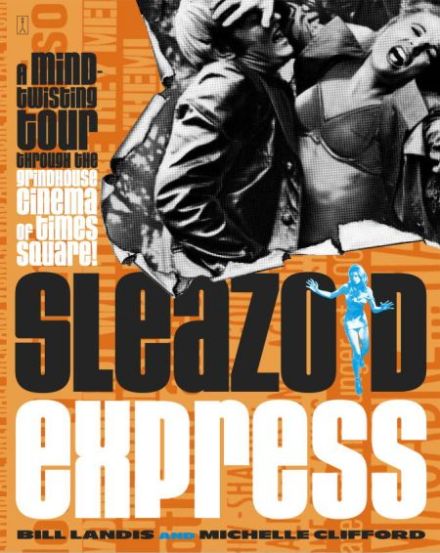
“Sleazoid Express / Metasex” – Bill Landis & Michelle Clifford

Image

Typical of most discussions of sexuality and deviance in America, most of the writing about 1960s – 1980s era Times Square utilizes a variety of distancing techniques, including condemnation, mindless celebration, irony, or a dry “ethnographic” approach. However different these styles appear to be on the surface, they all share the fact that most of the authors of these texts are outsiders, writing about the period as observers and “researchers.” Bill Landis’s “Sleazoid Express” and Michelle Clifford’s “Metasex” were brilliant self-published monographs (though Clifford and Landis contributed significantly to each other’s publications) that were different not only because they personally knew many of the people of this world, but they applied a human touch missing from everything else written about this subject.

“Sleazoid Express” and “Metasex” focused on the films and, more importantly, the people who lived, worked, and breathed the porn/vice lifestyle during this period. Landis and Clifford not only offered some of the most in-depth and insightful criticism of the exploitation films that played Times Square, but also profiled the filmmakers, actors, theaters, employees, and customers.  The reviews were terrific, because they didn’t distinguish between art and exploitation.  The denominator that mattered was that a film told the truth.

The personal profiles were where Landis and Clifford excelled, mainly due to their ability to humanize their subjects and not turn them in to martyrs, icons, or creeps.  There were rarely any heroes and villains in Landis’s and Clifford’s profiles and if there were villains, they were typically hypocrites, liars, and people who channelled their own vices/deviance into crusades or schemes against the people they are outwardly condemning. The depth and complexity with which Landis and Clifford wrote about their subjects not only separated their writing from everyone else’s, but also raised it to the level of art.

Landis and Clifford had a unique perspective and sensitivity towards telling the truth about what they saw and experienced and the people they knew from that world. Their approach also complicated one’s reaction to such material, since one was never sure whether to condemn, admire, or feel sorry for the people they wrote about. It also didn’t fit into any of the typical categories much of this writing typically falls into: 1) the porn is evil perspective; 2) the mindless “sex positive” perspective; 3) the smart-alecky “look at the freaks” perspective, or; 4) the academic “ethnographic” perspective.

This is not to say Landis’s and Clifford’s work lacked humor, but it’s difficult to approach this material in any kind of smart-alecky fashion once certain images are burned into one’s head. It’s incredibly powerful and complex stuff.

Landis and Clifford were the only two people documenting this era as it really happened, since everyone else who lived through the things they did are either dead, in prison, burned out, or MIA.  Sadly, Landis passed away in 2008.  Fortunately, Clifford is still around and in 2011, Clifford appeared on an episode of the stellar Projection Booth podcast during their Kenneth Anger special (Clifford and Landis co-wrote the brilliant Kenneth Anger biography “Anger” in 1995).

http://projection-booth.blogspot.com/2011/09/episode-27-kenneth-anger-magick-lantern.html

Also, a version of Clifford’s infamous Jamie Gillis profile (from Metasex #4) is included in the 2011 anthology “From the Arthouse to the Grindhouse: Highbrow & Lowbrow Transgression in Cinema’s First Century” by John Cline and Robert G. Weiner.  You can still find “Anger” and the “Sleazoid Express” books Landis and Clifford wrote in 2002 on Amazon and are worth reading.  And if you can find copies of the original “Sleazoid Express” or “Metasex” monographs, they’re definitely worth tracking down.