“Switchblade” – Link Wray

Video

From the 1979 album “Bullshot,” here’s another nasty, disreputable slab of menace from the incredible Link Wray. Aside from the title spoken at the beginning, “Switchblade” has no words. However, trust me when I say that this track is far more volatile than even the crudest Marilyn Manson song. This is dangerous stuff, even more so considering Wray was around 50 years old when he recorded this.

“Nebraska” (2013) dir. Alexander Payne, scr. Bob Nelson

Video

In a year of admittedly very strong films, it’s still a shame “Nebraska” didn’t walk off with a single Oscar at the 2013 Academy Awards. It’s one of the best American films of the last several years and one of the best films about the concept of family ever made.

As much as the film, its director, its writer and stars Bruce Dern and Jane Squibb have earned much-deserved accolades, sadly missing is recognition for Will Forte’s performance. It may be a straight-man performance, but arguably, Forte is the film’s heart-and-soul and what keeps “Nebraska” from being the heartless kick to the Heartland’s gut that some critics have accused it of.

The film’s premise is simple. Elderly Woody Grant (played by Bruce Dern) receives notification in the mail from a magazine subscription company that he may have won $1,000,000. However, Grant believes he’s actually won the million dollars and wants to go to Nebraska to claim his prize. Everyone tries to convince him it’s a scam, but Woody believes otherwise. His wife of several years, Kate (played by Jane Squibb), has written Woody off as a loser and a drunk and constantly berates him for how foolish he is. However, their well-meaning and long-suffering son David (played by Will Forte) decides to take his Dad to Lincoln, Nebraska to learn the truth about his prize, mainly because Woody won’t have it any other way.

What starts out in David’s mind as a chance to bond with a father who has been neglectful turns into a far different experience than he ever imagined. David is an unsuccessful home theater salesman who has just been given the axe by a girlfriend because he can’t commit to marriage. Given the toxicity of his own parents’ union, it’s easy to understand his trepidation over the idea of marriage. When he asks his father whether he ever wanted to have children, Woody’s response shocks him: “I liked to screw, and your mother’s a Catholic, so you figure it out.” They stay with Woody’s family in the town where Woody grew up and the family’s homespun charm turns venal when Woody carelessly tells them about his impending fortune and they start laying claim to past debts both real and imagined.

Despite a lot of funny moments, “Nebraska” is a profoundly sad film. However, it’s also a very moving tribute to Forte’s character David. David’s quest to bring his aging father one last shot at happiness and to bond with a severely flawed person who has done nothing to earn such efforts is heroic. David’s perseverance in giving his father his dignity may seem misguided, but it’s an affirmation of the humanity in even the most screwed-up individuals.

Forte plays a character trying to manage several volatile personalities that are important to him. Because it’s not a particularly showy role, it’s easy to dismiss it in the whirlwind kicked by Dern, Squibb, and Stacy Keach playing Woody’s embittered ex-business partner. When David finally explodes (similar to an earlier explosion by Kate), it is not a careless expression of emotion, but the only logical response to an escalating series of indignities. Despite what many people feel about their families, when someone is threatened, all past hostilities and grudges are quickly laid to rest to defend the slighted party.

“Nebraska” is a tremendously complex film that will stay with you a long time and is a genuine American classic.

“Joey’s on the Street Again” – The Boomtown Rats

Video

I always thought this Irish version of 1970s Bruce Springsteen was pretty cool. The Boomtown Rats would never earn points for originality, but they did produce a lot of great singles during the mid-late 1970s / early 1980s, many of which were very popular in the UK and Ireland. Their greatest hits album released in the early 2000s has been one of my most played albums for the past 10 years.

“I Hear You Knocking” – Smiley Lewis

Video

According to Tony Russell’s book “The Blues – From Robert Johnson to Robert Cray,” Lewis was described as “the unluckiest man in New Orleans. He hit on a formula for slow-rocking, small-band numbers like ‘The Bells Are Ringing’ and ‘I Hear You Knocking’ only to have Fats Domino come up behind him with similar music more ingratiatingly delivered. Lewis was practically drowned in Domino’s backwash.” Ouch! I don’t want to dump on Domino, because I love his music dearly, but it’s a shame Lewis is not as famous.

To add insult to injury, Dave Edmunds’s 1970 cover of Lewis’s “I Hear You Knocking” is better known than the original. While the Edmunds song is justifiably considered a classic, Lewis’s original is so damn good. It’s a slightly edgier version of Domino’s New Orleans R&B and the song should be a staple on Oldies stations, but sadly isn’t. Raise a glass of fine bourbon in Lewis’s honor.

“The Rocker” – Thin Lizzy

Video

From 1973’s “Vagabonds of the Western World,” here’s one of Thin Lizzy’s best songs: “The Rocker.” Thin Lizzy is one of those bands I’ve grown increasingly fond of over the years. They’re a terrific, unpretentious hard rock band with soul. In America, I think they’re ridiculously underrated and aside from “The Boys are Back in Town,” “Jailbreak,” and maybe “Whiskey in the Jar,” you’d never know they’d ever recorded anything else.

“The Rocker” is a great balls-out 70s hard rock song. While it failed to chart in the US and Britain, it did get as high as #11 in Ireland. The extended guitar solo by Eric Bell on this song is one of the sickest solos in rock history. The song appeared last year in the critically acclaimed-Ron Howard film “Rush.”

“Clones (We’re All)” – Alice Cooper

Video

Since the rise of punk / New Wave in the late 1970s made little commercial impact in the United States, most rock stars of the era just shrugged their shoulders and kept pumping out the same formulaic rock that got radio airplay and sold records. However, there were a few that attempted to understand the music and put their own spin on the new genre. Peter Gabriel is arguably the most commercially successful of these classic rock artists who dipped their toe into the New Wave pool. Alice Cooper? Not so much, but this is not due to the fact that the music was lacking.

Alice Cooper’s New Wave attempt from 1980, “Clones (We’re All),” from his “Flush the Fashion” album, is actually very good … not that far removed from Gary Numan or Peter Gabriel’s self-titled third album released that same year. “Clones” actually scraped into the Top 40 back then, but is pretty much forgotten these days. Some truly progressive 80s or New Wave radio programmer should seriously consider dropping this into their station mix.

“GG Allin – Son of Evil” by Dan Moxham

Image

When my wife opened the package from Amazon.com and noticed this book, she barely … but distincntly … raised an eyebrow and said … in that smart-ass way I’ve grown to dread and love … “Oh .. what a ‘wonderful’ purchase you made.” My wife forgets that GG Allin, the notorious poop-eating self-mutilator from New Hampshire played a pivotal role in an internship she had prior to when we got married. You see, I had a videocassette of one of GG’s legendary “performances” that magically shot out of a toilet somewhere … sanitized, by the way … and landed mysteriously in my VHS collection (I swear). Anyway, when the mentor in charge of my then fiance’s internship learned I had a videotape of GG’s shenanigans, he desperately begged to see it. I loaned him my tape … for educational purposes … and my wife got high marks on her internship. Granted, much of that was due to my wife’s talent, but I imagine some of that had to do with the madman from New Hampshire.

But I must start at an earlier date. Let’s start 29 years ago in the year 1985.  I was reading the punk zine “Maximum Rock N’ Roll” and there was a letter in the letters section that caught my eye.  It was from a performer who called himself “GG Allin” who bragged about pooping on stage and eating said poop, in addition to beating the snot out of audience members and causing other mayhem to himself and others.  Being all of 15-years old, I laughed hysterically.  In fact, I hadn’t laughed this hard since I read a synopsis of the John Waters’ film “Pink Flamingos” three years earlier in Danny Peary’s seminal alt-cinema book “Cult Movies.”  Here … I thought … was a real-life version of a John Waters-film character. 

I kept tabs on GG over the years, eventually scoring a bootleg cassette my first semester of college in 1988 of a live performance GG did from Texas in 1985 when he performed with a band called “The Texas Nazis.”  The quality of the tape was terrible, but while I heard GG perform many “songs,” the highlight was GG baiting the audience with violent sexual taunts and threatening to throw his poop on them. This odd cassette, which also contained some answering machine messages for GG, as well as some tracks from Nico’s first solo album “Chelsea Girls,” was a prized selection in my tape library during my college years.

During this time, GG threatened to commit suicide live on stage … and to take some audience members with him, but always seemed to find himself in jail when said moment arrived. While I don’t doubt his sincerity in his mission, the execution of his plan always seemed to be hindered by his drug abuse and penchant for always doing the wrong thing at the wrong time. Which of course, led to his death by drug overdose in 1993.

Dan Moxham’s book “GG Allin – Son of Evil” may not be the definitive biography GG fans have been waiting for, but it is a worthy document nonetheless. The book is not a straight biography, per se, but it is a chronicle of GG’s misadventures over the years, along with song lyrics, rants, and poetry. It’s more of a compilation than straight biography. But considering the fact that no major publisher … or even minor publisher of note … is announcing any GG biography in the near future, Moxham’s book will have to do. Trust me, there’s more than enough bile to send shivers up the most jaded masochist’s spine. And credit is due to Moxham putting pen to ink to memorialize the most notorious rock and roll performer of all-time. As much as I admire Marilyn Manson, he doesn’t even come close.

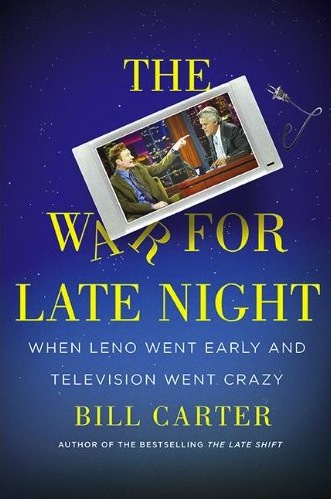
“The War for Late Night” by Bill Carter

Image

With all the hubbub this week re: Jimmy Fallon finally ascending to the role of “Tonight Show” host on NBC, I read Bill Carter’s 2010 chronicle of the last disastrous “Tonight Show” host transition, “The War for Late Night: When Leno Went Early and Television Went Crazy.”  In my mind, it’s the equal of Carter’s earlier book about the late night wars “The Late Shift,” and one of the best books about show business ever written … with an emphasis on “the business” part of that phrase.  It’s a great primer on why “win-win” solutions that look good on paper oftentimes result in disaster.  And it’s the perfect illustration of that old cliche: “You can’t have your cake and eat it too.”

Let’s go down memory lane to the early 2000s… and forgive me if I’m skipping over several key events because I don’t want this to sidetrack my main point:  Jay Leno’s “Tonight Show” was at the top of the ratings for late night talk shows.  However, Conan O’Brien, who hosted the show that came on after the “Tonight Show” (“Late Night”), was scoring bigger ratings among younger viewers, the most prized demographic for advertisers.  It’s the reason why the “Red Skelton Hour” (a Top 10 show) was dropped by CBS in the early 1970s, because the audiences were not the type that brought in big advertising dollars.   Other networks noticed Conan’s appeal among younger viewers  and offered him as much as $20 million a year to leave NBC.  As a result, NBC was desperate to keep Conan. 

At the time, NBC wasn’t about to pay that kind of money to keep Conan (Jay still earned less than $20 million per year), but they had a huge ace up their sleeve:  Conan’s dream of hosting the “Tonight Show” one day.  They did not match what other networks were offering Conan dollar-wise, but agreed to give Conan the “Tonight Show” in 2009, in order to extend his stay at “Late Night” further … with a huge financial penalty (approximately $45 million)  if NBC reneged.  Conan readily agreed.   First problem solved.

Second problem?  What to do about Jay.  Jay was not only scoring the highest ratings in late night, but he genuinely loved his job hosting the “Tonight Show” and most importantly, was in no hurry to leave.  Like Conan, Leno could have made a lot more money going elsewhere (David Letterman’s salary was substantially higher on CBS), but stayed on as the “Tonight Show” host because of his genuine love for the prestige such a gig had.  They told Leno they would extend his contract, but with the agreement in 2009 that he would step down.  The decision hit Jay like a sledgehammer to the gut.  He warily agreed, but started making his resentment clear by making sharp remarks about the situation in his “Tonight Show” monologues and started negotiating behind the scenes to go to another network.

The suits at NBC panicked.  While they wanted to keep Conan, they didn’t want to lose Jay to another network and have Jay potentially come out on top elsewhere.  Their solution?  To give Jay a 10:00 pm show where he could still do his monologue and other comedy bits, but Conan could keep the “Tonight Show.”  Since NBC was in the ratings cellar, moving Jay to 10:00 pm five nights a week, even with paying him more money per year, was substantially cheaper than developing and producing five new dramatic shows.  Plus, since Jay’s audience was skewing older, it made sense at the time to put him in prime time.  The solution first struck both Jay and Conan as unorthodox, but they agreed.   The decision was announced with much fanfare and the NBC suits appeared to be geniuses, averting the ugliness that prevailed in 1993 during the prior “Tonight Show” transition between Johnny Carson and Jay.  Ah … but reality has a funny way of spoiling the best laid plans.

The reality?  Jay’s show bombed at 10:00 pm.  While Jay’s new show was not that radically different than his old “Tonight Show,” it became clear that what works in one time slot may not work well in another. Affiliates were up in arms over the low ratings and threatened to yank the show off their stations.  Conan, on the other hand, was doing merely OK on the “Tonight Show.”  While he was still pulling in the more prized demographic, he was losing in overall viewership to Letterman’s show, which was on top for the first time in several years.  The suits proposed moving Jay’s show to 11:35 pm and moving Conan’s show to 12:05 am.  Jay agreed, but Conan balked.  Yes, Conan would still technically be hosting “Tonight Show,” but it would be on at 12:05 am … rendering the title “Tonight Show” technically meaningless and in Conan’s mind, diminishing the prestige and history of the long-time late night show.

I should point out the fatal flaw Conan’s team made in signing their contract.  While Conan was specifically given the “Tonight Show” in his contract, there was no time-slot protection, a major clause in all major late night host’s contracts.  Which means that NBC could technically stick the “Tonight Show” almost anywhere in the schedule and they would still be in compliance of their contract.  Conan was not pleased with things, but was still mulling things over when NBC made a fatal mistake.  Desperate to get Conan’s thumbs-up before an affiliate’s meeting, NBC head Jeffrey Zucker started playing hardball with Conan’s team. That, plus the fact that Conan’s team was literally the last to know about these plans (even Jimmy Fallon, who took over “Late Night” after Conan went to the “Tonight Show,” knew of this plan before Conan did), finally, in Conan’s words, cured him of his “Tonight Show” addiction.

As we all know, things got extremely ugly amongst all parties involved.  Jay’s fans wondered why Conan would be making such a big deal about doing his show 30 minutes later.  Conan’s fans painted Jay as the Baby Boomer who stayed too long at the party and refused to get off the stage.  And remembering the Machiavellian way Jay … or his management team at the time … beat Letterman for the “Tonight Show” gig in 1993 indicated this was another example of Jay’s treachery.   Conan’s side definitely got the most favorable press at the time and for good reason: Conan was treated abysmally in this situation by NBC and Conan did have a good point about the new plan diminishing the legacy and history of the “Tonight Show.” But objectively, Jay was not the bad guy in this situation either.  As Jay indicated, there was another side to this story: the older guy who’s doing well in his job, but is asked to step aside by the bosses at the top to make way for someone younger.   Jay’s grumblings about going elsewhere during the “lame duck” period between 2005 and 2009 is perfectly understandable.  And NBC trying to find a solution to keep Jay in the fold does make sense, especially since Jay could have potentially done very well going elsewhere.

To be fair to the much maligned Zucker, the initial solution to keep Jay on NBC by giving him a 10:00 pm show was not hastily decided.  The decision did make a lot of sense based on the research they conducted and the network’s financial realities.   And, had both Jay’s and Conan’s shows had more time to work out their bugs and get into a groove, there’s a possibility both shows may eventually would have survived and thrived.   But affiliates were losing viewers and money, and their threatened boycott did not allow enough time for this to happen.

As we all know, a solution was worked out between all parties, but resulted in a lot of bad feelings.  Carter’s account of this debacle  (which includes many other fascinating subplots and characters) is a terrific examination of how pleasing everyone oftentimes leads to pleasing no one.