KISS Live in Japan 1977

You wanted the best, you got the best!  It’s KISS!  At the height of their powers in 1977!  With all four original members! Performing live in Japan!  .. (exclamation points officially ending here) … This was recorded for HBO and I remember seeing this very concert during the summer of 1979 when me and my brother went to visit my Dad in Northern Virginia.   Two of my Dad’s female neighbors in their early 20s invited us all over to watch the concert on their TV since they had HBO.   I can’t imagine my Dad’s neighbors were particularly interested in KISS … or my brother and me, for that matter … but I’m not going to complain that they used my interest in KISS to get to know my Dad better.  It was doubly cool because I was now able to see my favorite band at the time life, I also got to check out this thing called HBO that I had seen advertised on TV, but wouldn’t be available in my neighborhood for two more years.  As always, Paul Stanley doesn’t disappoint with his stage raps here.

“Box of Rain” – The Grateful Dead as seen in the TV series “Freaks and Geeks” (2000)

Another wonderful moment from the stellar TV show “Freaks and Geeks” involving rock music.  This is from the final episode, where Lindsay Weir, a high school honor student disenchanted with the expectations put upon her, puts on the Grateful Dead’s “American Beauty” album and really connects with it, especially the opening track “Box of Rain.” 

“I’m One” – The Who from “Quadrophenia” as seen in “Freaks and Geeks”

Ever since I introduced the late 1990s TV show “Freaks & Geeks” to my son a few weeks ago, he has binge-watched the entire one-season show (18 hours) at least 5-6 times on Netflix.  It’s been nice reconnecting with the best show ever to be broadcast on TV about teenagers, if not one of the best series in TV history.

This particular scene is one of my favorites.  It’s one where the geekiest of the geeks, latchkey child Bill Haverchuck, comes home after school to watch TV by himself.  He catches an early TV appearance by comedian Garry Shandling and experiences a moment of unbridled joy laughing at Shandling and just hanging by himself.  I know that many people paint the life of a latchkey kid as unbearably tragic.  But speaking as a latchkey kid myself, sorry Dr. Laura, I had a f–king blast! And no, it’s not because I used the alone time to drink alcohol, do drugs, use my bedroom as a f–kpad, or look at porn.  I realize this is anathema to common ideas of parenting these days, but sometimes kids just need one-two hours a day to do absolutely nothing but veg.  Yes, socializing, exercising, doing school activities, etc. are important, but vegging is seriously underrated and kids these days don’t do enough of it. 

Anyway, I love the way that The Who’s “I’m One” … one of the best, but least-heralded tracks from their great album “Quadrophenia” is used in this scene.  One of the best uses of popular music for dramatic purposes ever.

“Come Sail Away” – Styx from “Freaks and Geeks” (1999)

First of all, you need to understand how much I loathe “Come Sail Away” by Styx.  If it were a federal hate crime to discriminate against a song, I’d be doing hard time in federal prison for committing crimes against this one.

But … this song works soooooo damn well in this wonderful scene from the first episode of “Freaks and Geeks,” the greatest show in television history about teenagers … and if truth be told … kicks the a– of any of the “best” feature films ever made about teenagers.

This is a scene from the Homecoming dance, where freshman Sam Weir shows up at the dance because his crush, cheerleader Cindy Sanders, promised him a dance.  She fulfills her promise and the dance between these two always lifts my mood.  Some moments are so incredibly sweet that if you dislike them, there is something seriously wrong with you.   As awkward as Sam is here, he has bigger balls than I did at the age of 14.

“Rev Meets God” from the BBC TV series “Rev”

This scene is the arguably the emotional climax of the BBC series “Rev.”  If you haven’t seen it, you probably should watch the entire series on Hulu Plus (if you’re in America).   It’s a funny, but also dramatic and complex show about a well-meaning, but seriously flawed Anglican priest played by Tom Hollander.  This scene comes near the end of its final season when the priest is at his lowest point, personally and professionally.

I’m not particularly religious, but this scene sums up what I understand God means for many people.  I realize women already think Liam Neeson IS God, but if God were to take human form, we as humanity could do a lot worse than Neeson’s characterization here.  There’s a good reason why Steven Spielberg picked Neeson to play Oskar Schindler in “Schindler’s List” over his alleged first choice, Alan Thicke.  No, I can’t quite figure out why Spielberg wanted Thicke for that role either.

The “fat girl” speech from “Louie”

Video

http://www.youtube.com/watch?v=KFdWcNJ17YY

I don’t have much to add to all the praise and hubbub that this episode is generating out there. But it’s a prime illustration of why “Louie” is one of the coolest, ballsiest TV shows of all time. “Louie” has continually been one of those shows that’s hysterically … oftentimes profanely … funny, but isn’t afraid to get serious if that’s what the moment calls for. And when I mean serious, it’s not in “a very special episode” kind of way. The common denominator on “Louie” is exposing what’s real. It treads the line between funny and serious better than almost anything I’ve ever seen.

A friend of mine once told me he had difficulty seeing what all the fuss was about re: “Louie.” I advised to not think of it like a sitcom, but to watch it the same way you would watch a Spike Lee film. Lee’s films are oftentimes really funny and serious as s–t … sometimes going back in forth several times between both poles in scenes lasting no more than 5 minutes.

GG Allin on “Geraldo” (1992)

Video

http://www.youtube.com/watch?v=Wbej9YNg1yg

A classic episode of “Geraldo” from the early 1990s featuring everyone’s favorite self-mutilating, poop-eating rock singer G.G. Allin. The episode is about “obscene art” and Geraldo Rivera is in classic form, condemning extreme art while also giving his audience multiple tastes of such art in a way that pushes the boundaries of what’s acceptable within the realms of early 1990s broadcast TV. It’s the classic “This is sick, folks. Take a look at how sick this stuff is! Don’t you agree? Let’s get a close-up folks, in case you don’t understand how sick this is” approach. OK, not work safe, but a fine example of pre-internet shock value … allowing an audience an acceptable way to engage in hideous behavior by keeping their hands clean by tsk-tsking the dirt off their hands.

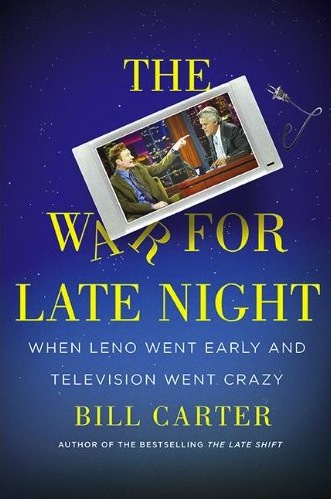
“The War for Late Night” by Bill Carter

Image

With all the hubbub this week re: Jimmy Fallon finally ascending to the role of “Tonight Show” host on NBC, I read Bill Carter’s 2010 chronicle of the last disastrous “Tonight Show” host transition, “The War for Late Night: When Leno Went Early and Television Went Crazy.”  In my mind, it’s the equal of Carter’s earlier book about the late night wars “The Late Shift,” and one of the best books about show business ever written … with an emphasis on “the business” part of that phrase.  It’s a great primer on why “win-win” solutions that look good on paper oftentimes result in disaster.  And it’s the perfect illustration of that old cliche: “You can’t have your cake and eat it too.”

Let’s go down memory lane to the early 2000s… and forgive me if I’m skipping over several key events because I don’t want this to sidetrack my main point:  Jay Leno’s “Tonight Show” was at the top of the ratings for late night talk shows.  However, Conan O’Brien, who hosted the show that came on after the “Tonight Show” (“Late Night”), was scoring bigger ratings among younger viewers, the most prized demographic for advertisers.  It’s the reason why the “Red Skelton Hour” (a Top 10 show) was dropped by CBS in the early 1970s, because the audiences were not the type that brought in big advertising dollars.   Other networks noticed Conan’s appeal among younger viewers  and offered him as much as $20 million a year to leave NBC.  As a result, NBC was desperate to keep Conan. 

At the time, NBC wasn’t about to pay that kind of money to keep Conan (Jay still earned less than $20 million per year), but they had a huge ace up their sleeve:  Conan’s dream of hosting the “Tonight Show” one day.  They did not match what other networks were offering Conan dollar-wise, but agreed to give Conan the “Tonight Show” in 2009, in order to extend his stay at “Late Night” further … with a huge financial penalty (approximately $45 million)  if NBC reneged.  Conan readily agreed.   First problem solved.

Second problem?  What to do about Jay.  Jay was not only scoring the highest ratings in late night, but he genuinely loved his job hosting the “Tonight Show” and most importantly, was in no hurry to leave.  Like Conan, Leno could have made a lot more money going elsewhere (David Letterman’s salary was substantially higher on CBS), but stayed on as the “Tonight Show” host because of his genuine love for the prestige such a gig had.  They told Leno they would extend his contract, but with the agreement in 2009 that he would step down.  The decision hit Jay like a sledgehammer to the gut.  He warily agreed, but started making his resentment clear by making sharp remarks about the situation in his “Tonight Show” monologues and started negotiating behind the scenes to go to another network.

The suits at NBC panicked.  While they wanted to keep Conan, they didn’t want to lose Jay to another network and have Jay potentially come out on top elsewhere.  Their solution?  To give Jay a 10:00 pm show where he could still do his monologue and other comedy bits, but Conan could keep the “Tonight Show.”  Since NBC was in the ratings cellar, moving Jay to 10:00 pm five nights a week, even with paying him more money per year, was substantially cheaper than developing and producing five new dramatic shows.  Plus, since Jay’s audience was skewing older, it made sense at the time to put him in prime time.  The solution first struck both Jay and Conan as unorthodox, but they agreed.   The decision was announced with much fanfare and the NBC suits appeared to be geniuses, averting the ugliness that prevailed in 1993 during the prior “Tonight Show” transition between Johnny Carson and Jay.  Ah … but reality has a funny way of spoiling the best laid plans.

The reality?  Jay’s show bombed at 10:00 pm.  While Jay’s new show was not that radically different than his old “Tonight Show,” it became clear that what works in one time slot may not work well in another. Affiliates were up in arms over the low ratings and threatened to yank the show off their stations.  Conan, on the other hand, was doing merely OK on the “Tonight Show.”  While he was still pulling in the more prized demographic, he was losing in overall viewership to Letterman’s show, which was on top for the first time in several years.  The suits proposed moving Jay’s show to 11:35 pm and moving Conan’s show to 12:05 am.  Jay agreed, but Conan balked.  Yes, Conan would still technically be hosting “Tonight Show,” but it would be on at 12:05 am … rendering the title “Tonight Show” technically meaningless and in Conan’s mind, diminishing the prestige and history of the long-time late night show.

I should point out the fatal flaw Conan’s team made in signing their contract.  While Conan was specifically given the “Tonight Show” in his contract, there was no time-slot protection, a major clause in all major late night host’s contracts.  Which means that NBC could technically stick the “Tonight Show” almost anywhere in the schedule and they would still be in compliance of their contract.  Conan was not pleased with things, but was still mulling things over when NBC made a fatal mistake.  Desperate to get Conan’s thumbs-up before an affiliate’s meeting, NBC head Jeffrey Zucker started playing hardball with Conan’s team. That, plus the fact that Conan’s team was literally the last to know about these plans (even Jimmy Fallon, who took over “Late Night” after Conan went to the “Tonight Show,” knew of this plan before Conan did), finally, in Conan’s words, cured him of his “Tonight Show” addiction.

As we all know, things got extremely ugly amongst all parties involved.  Jay’s fans wondered why Conan would be making such a big deal about doing his show 30 minutes later.  Conan’s fans painted Jay as the Baby Boomer who stayed too long at the party and refused to get off the stage.  And remembering the Machiavellian way Jay … or his management team at the time … beat Letterman for the “Tonight Show” gig in 1993 indicated this was another example of Jay’s treachery.   Conan’s side definitely got the most favorable press at the time and for good reason: Conan was treated abysmally in this situation by NBC and Conan did have a good point about the new plan diminishing the legacy and history of the “Tonight Show.” But objectively, Jay was not the bad guy in this situation either.  As Jay indicated, there was another side to this story: the older guy who’s doing well in his job, but is asked to step aside by the bosses at the top to make way for someone younger.   Jay’s grumblings about going elsewhere during the “lame duck” period between 2005 and 2009 is perfectly understandable.  And NBC trying to find a solution to keep Jay in the fold does make sense, especially since Jay could have potentially done very well going elsewhere.

To be fair to the much maligned Zucker, the initial solution to keep Jay on NBC by giving him a 10:00 pm show was not hastily decided.  The decision did make a lot of sense based on the research they conducted and the network’s financial realities.   And, had both Jay’s and Conan’s shows had more time to work out their bugs and get into a groove, there’s a possibility both shows may eventually would have survived and thrived.   But affiliates were losing viewers and money, and their threatened boycott did not allow enough time for this to happen.

As we all know, a solution was worked out between all parties, but resulted in a lot of bad feelings.  Carter’s account of this debacle  (which includes many other fascinating subplots and characters) is a terrific examination of how pleasing everyone oftentimes leads to pleasing no one. 


Jason Segal as Nick Andopolis from “Freaks and Geeks” (1999-2000)

Video

Of all the characters that I most painfully identified with on the genius short-lived TV show “Freaks and Geeks,” it was Jason Segal’s Nick Andopolis character. Well-meaning, but WAAAAAY too f–king sensitive and intense for the room, the writers/producers absolutely nailed a very certain personality type that’s difficult to articulate or depict.

I love the facial expressions of Linda Cardellini’s Lindsay character as she’s trying to take Nick’s display of “love” in. I also like the way Nick tries to process the news that Lindsay needs a break in a way where he’s using every ounce of his being to try and keep it “cool.” That’s very, very good acting on Segal’s part.

For the record, age and maturity have helped me develop a very good bulls–t detector for myself over the years. My gratitude to everyone who knew me back in the day and still finds me friend-worthy these days. I fully understand it wasn’t easy.

“Theme from S.W.A.T.” – Rhythm Heritage

Video

This was the first record I ever bought with my own money … I think in early 1976. And damn … even nearly 40 years later … this music still makes me want to crash a large American car through a plate glass window, jump out of the car with my flares, leather jacket, and .38 while subduing some thug in a ski mask, and then … cut to me curling up next to two ladies in bikinis on a leather sofa while giving the camera a wink and thumbs up while holding a glass of scotch.  Stay classy!