“Superman III” analysis by the “How Did This Get Made?” podcast

Superman III LIVE!

One of my favorite movie podcasts … and so far, the funniest … is “How Did This Get Made?”  The podcast is comedians Paul Scheer, Jason Mantzoukas, and June Diane Raphael (with the occasional additional commentator) discussing the most ridiculous films ever made.  While this is the theme for countless movie podcasts, Scheer, Mantzoukas, and Raphael are actually, really really funny.  And … most importantly … they seem to understand what makes certain bad movies better than others.  It’s not enough to be schlocky.  Being schlocky is easy and in most cases, extremely dull.  But trust me when I say that that it takes a certain kind of genius to make a film as astonishing as “Road House,” “Cool as Ice,” or “The Room.”  They may not be “good” in the conventional sense.  But they’re not boring.  These are very special movies that are positively f–king insane!  

I listened to many of their episodes today and loved what I heard.  But the best of all of them was their dissection of Richard Lester’s 1983 sequel “Superman III” (the one with Richard Pryor).  “Superman III” is not the worst of the Superman films (“Superman IV” makes “Superman III” look like “Pulp Fiction”), but it’s still pretty awful.  I never thought this film was particularly good or even enjoyably bad until Scheer, Mantzoukas, and Raphael (with guest Damon Lindelof) analyzed this film the way scholars analyze “Citizen Kane,” pointing out wild inconsistencies and just flat-out bizarre plot twists that demonstrate that this is truly a much more bats–t crazy film than I remember.  Regardless of whether you agree with their analysis, it’s one of the most hilarious movie reviews I’ve ever experienced … and easily one of the most fun.  The language can be a bit rough, so not safe for work or little ones.

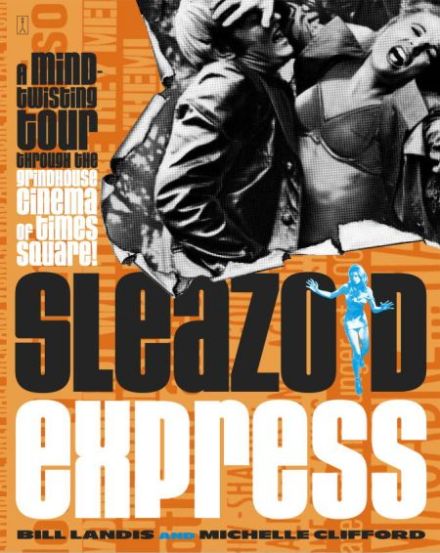
“Sleazoid Express / Metasex” – Bill Landis & Michelle Clifford

Image

Typical of most discussions of sexuality and deviance in America, most of the writing about 1960s – 1980s era Times Square utilizes a variety of distancing techniques, including condemnation, mindless celebration, irony, or a dry “ethnographic” approach. However different these styles appear to be on the surface, they all share the fact that most of the authors of these texts are outsiders, writing about the period as observers and “researchers.” Bill Landis’s “Sleazoid Express” and Michelle Clifford’s “Metasex” were brilliant self-published monographs (though Clifford and Landis contributed significantly to each other’s publications) that were different not only because they personally knew many of the people of this world, but they applied a human touch missing from everything else written about this subject.

“Sleazoid Express” and “Metasex” focused on the films and, more importantly, the people who lived, worked, and breathed the porn/vice lifestyle during this period. Landis and Clifford not only offered some of the most in-depth and insightful criticism of the exploitation films that played Times Square, but also profiled the filmmakers, actors, theaters, employees, and customers.  The reviews were terrific, because they didn’t distinguish between art and exploitation.  The denominator that mattered was that a film told the truth.

The personal profiles were where Landis and Clifford excelled, mainly due to their ability to humanize their subjects and not turn them in to martyrs, icons, or creeps.  There were rarely any heroes and villains in Landis’s and Clifford’s profiles and if there were villains, they were typically hypocrites, liars, and people who channelled their own vices/deviance into crusades or schemes against the people they are outwardly condemning. The depth and complexity with which Landis and Clifford wrote about their subjects not only separated their writing from everyone else’s, but also raised it to the level of art.

Landis and Clifford had a unique perspective and sensitivity towards telling the truth about what they saw and experienced and the people they knew from that world. Their approach also complicated one’s reaction to such material, since one was never sure whether to condemn, admire, or feel sorry for the people they wrote about. It also didn’t fit into any of the typical categories much of this writing typically falls into: 1) the porn is evil perspective; 2) the mindless “sex positive” perspective; 3) the smart-alecky “look at the freaks” perspective, or; 4) the academic “ethnographic” perspective.

This is not to say Landis’s and Clifford’s work lacked humor, but it’s difficult to approach this material in any kind of smart-alecky fashion once certain images are burned into one’s head. It’s incredibly powerful and complex stuff.

Landis and Clifford were the only two people documenting this era as it really happened, since everyone else who lived through the things they did are either dead, in prison, burned out, or MIA.  Sadly, Landis passed away in 2008.  Fortunately, Clifford is still around and in 2011, Clifford appeared on an episode of the stellar Projection Booth podcast during their Kenneth Anger special (Clifford and Landis co-wrote the brilliant Kenneth Anger biography “Anger” in 1995).

http://projection-booth.blogspot.com/2011/09/episode-27-kenneth-anger-magick-lantern.html

Also, a version of Clifford’s infamous Jamie Gillis profile (from Metasex #4) is included in the 2011 anthology “From the Arthouse to the Grindhouse: Highbrow & Lowbrow Transgression in Cinema’s First Century” by John Cline and Robert G. Weiner.  You can still find “Anger” and the “Sleazoid Express” books Landis and Clifford wrote in 2002 on Amazon and are worth reading.  And if you can find copies of the original “Sleazoid Express” or “Metasex” monographs, they’re definitely worth tracking down.

Redemption scene from “The Mission” (1986) dir. Roland Joffe

Video

At one point during the mid-1980s, Roland Joffe was considered one of the world’s best film directors. His first two films: “The Killing Fields” (1984) and “The Mission” were nominated for multiple Academy Awards, with a “work-in-progress” version of “The Mission” winning the Palme d’Or at the Cannes Film Festival in 1986.

Nowadays, Ennio Morricone’s stellar soundtrack for “The Mission” is better remembered than the film itself. Mainly because Joffe’s post “Mission” film career has not lived up to the promise of his first two films. I have mixed feelings about “The Mission,” but this scene never ceases to bring me to tears.

Robert DeNiro’s character is a South American slave-trader who kills his brother in a duel after he catches him in bed with his fiance. While DeNiro’s character is acquitted of legal wrong-doing, his guilt overwhelms him. A priest, played by Jeremy Irons, challenges him to undertake a suitable penance. The penance is to carry a heavy bundle, including his armor and sword, across many miles into the territory where he captured slaves. The people who he used to enslave recognize him, are ready to kill him, but under the guidance of Irons’ priest, cut him loose. DeNiro’s character’s acknowledgement of the grace of a people who were ready to slit his throat is heartbreaking.

You may recognize a young Liam Neeson in the background … approximately 20 years before he became our generation’s version of Charles Bronson.

“Harlem Shuffle” – The 5.6.7.8’s

Video

http://www.youtube.com/watch?v=023x9qPDjOU

F–k yeah! Japan’s garage punk femme fatales make absolute mincemeat out of Bob & Earl’s classic R&B song from 1963. The Rolling Stones may have scored the highest chart placement with their version from 1986, but the 5.6.7.8’s eat the Stones for breakfast on this one.

Trivia note: you may recognize the 5.6.7.8’s as the all-female Japanese rock band performing near the end of Quentin Tarantino’s “Kill Bill Vol. 1” before Uma Thurman kills about 500 or so Yakuza members with her sword.

http://www.youtube.com/watch?v=aR6qvkDDBCg

“The Velvet Underground and Nico: A Symphony of Sound” (1966) dir. Andy Warhol / Paul Morrissey

Video

http://www.youtube.com/watch?v=MBruudQ9bgE

Here is some classic footage of the Velvet Underground jamming out circa 1966, courtesy of Andy Warhol and Paul Morrissey. Considering that very little footage exists of this seminal band … and the fact that both Warhol and Morrissey thought enough to film this … makes this essential viewing. Put your shades on and groove, baby!

“The Spy Who Loved Me” (1977) dir. Lewis Gilbert

Video

Ah … in much the same way many men remember their first “adult beverage” or the first time they lost their virginity … I remember when I saw my first James Bond film. I was 7-years old and my older brother was doing something far cooler than what I was doing on a particular fall night in 1977. My mom offered to take me to the movies and when she asked me what I wanted to see, I said “The Spy Who Loved Me.” I’m not quite sure what my mom knew what she was getting into. But … it was PG-rated … so I guess she shrugged her shoulders and said “OK!”

For those born after the advent of the PG-13 rating, let me explain that a 1970s PG could sometimes be the equivalent of what would constitute a mild R-rating these days. And hoo boy, did “The Spy Who Loved Me” deliver! Granted, there was no overt nudity or graphic violence … but holy mackeral, it blew my pervy 7-year old mind! You can talk all you want to about “Skyfall.” Yes, “Skyfall” was the best Bond film in years … but that honor is like being the best Tears for Fears song in years. At best, it’s going to be merely OK.

With that being said, I have a very soft spot in my heart for “The Spy Who Loved Me.” This is … by far … my favorite Bond film. It promised a world of illicit pleasures that I didn’t quite understand, but seemed pretty f–king cool nonetheless. Never mind the fact that life is NEVER as cool as a James Bond film. But this one always brings a smile to my face.

The opening credits sequence alone is beyond awesome. Yes, it’s cheesy as all James Bond credit sequences often are. But if you’re not able to watch this without a smile on your face, you’re not human.

P.S.: I also watched “Snoopy Come Home” that same night on television when I got home and thought it was equally awesome. When you add in the pizza my Mom bought that night for dinner, I distinctly remember that particular day as one of the best of my young life.

John Waters’ Top 10 Films of 2013 (from Artforum)

http://www.indiewire.com/article/john-waters-top-films-of-2013-spring-breakers-is-1

Early December always brings cult filmmaker and raconteur John Waters’ immensely useful Top 10 film list for the year (published in Artforum). As always, he makes some very interesting choices and has some choice comments. Dave says check it out.

“When She Loved Me” – Sarah McLachlan / Randy Newman from “Toy Story 2” (1999)

Video

An incredibly moving and emotional scene from the Pixar animated film “Toy Story 2,” featuring one of Randy Newman’s best songs, sung by Sarah McLachlan. Yes, the characters are toys. Yes, I realize it’s some dire triumph of the Capitalist system to ascribe human feelings to otherwise inanimate objects. But I dare anyone not to watch this scene and not be moved. As I’ve said before, between 1995 and 2010 (15 years if you do the math), there has been no other creative entity that sustained a consistently high quality of films than Pixar did. Yes, they really showed their a– with “Cars 2.” But … here’s hoping they bounce back and start scoring classics again.

“Speak Now or Forever Hold Your Peace” – Terry Reid / Cheap Trick

Video

I first heard this song via Cheap Trick’s very heavy cover during the opening of Jonathan Kaplan’s classic late 1970s troubled youth film “Over the Edge.” Up until recently, I had no idea that Cheap Trick’s version wasn’t the original until I heard this on a Terry Reid compilation I picked up because I had always been curious about Reid, but had never heard his stuff before. Wow! As much as I love the Cheap Trick cover, this poppier, but still very heavy original is really cool. For comparison purposes, I am including a link to the Cheap Trick version below. I’m going to wimp out and call it a draw. A great song with two awesomely different interpretations.

http://www.youtube.com/watch?v=qMeA0Vzs9BA

“It’s a Wonderful Life” (alternate ending)

They just announced a sequel to “It’s a Wonderful Life.”  This is completely unnecessary.  All they have to do is release the Director’s Cut with this alternate ending intact (which premiered on “Saturday Night Live”).

http://www.ebaumsworld.com/video/watch/81249131/